
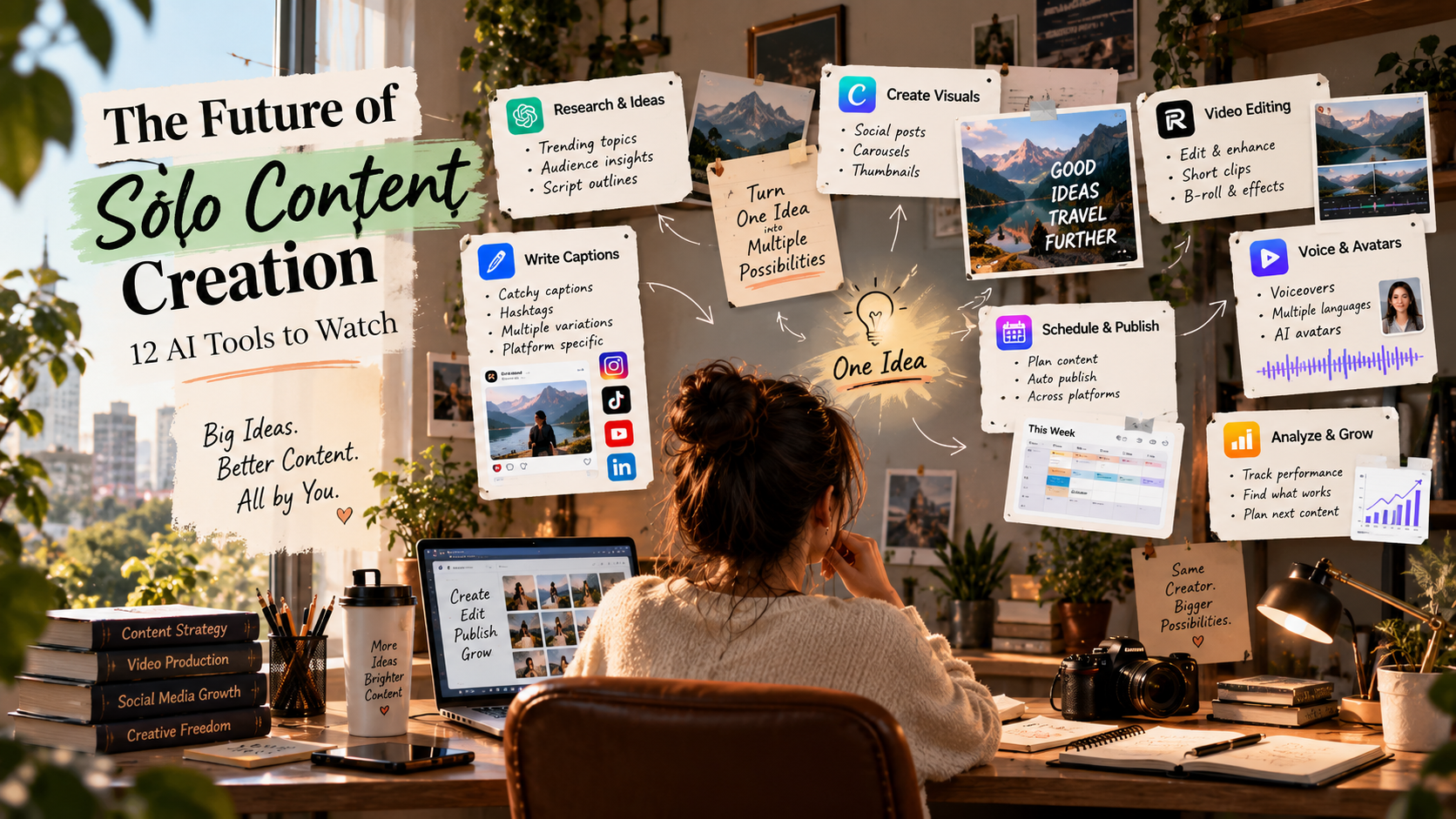
For years, creating high-quality content as a solo creator meant accepting a simple trade-off: you could either produce more content or spend more time making each piece better. Research, scripting, filming, editing, designing thumbnails, creating short-form clips, writing captions, and managing distribution could easily turn one video into a multi-day project.
AI is starting to change that equation.
The most interesting development isn’t that AI can generate a video or write a caption. It is that creators can now connect several AI-powered capabilities into a workflow that previously required multiple people. A solo YouTuber can research a topic, develop a script, generate supporting visuals, edit footage, create short clips, produce voiceovers, and prepare social content without handing every stage to a different specialist.
That doesn’t mean AI has suddenly made creativity automatic. Good creators still need ideas, judgment, personality, storytelling ability, and an understanding of their audience. What is changing is the amount of repetitive production work they have to handle themselves.
Here are 12 AI tools worth watching as this new creator workflow develops.
1. Predis.ai: Turning One Content Idea Into Multiple Assets
One of the biggest challenges for solo creators isn’t coming up with an idea; it is getting enough value from the ideas they already have. A useful video, article, product announcement, or campaign concept can often be adapted into several different pieces of social content, but doing that manually takes considerable time.
Predis.ai approaches this problem by helping creators turn an idea, product, URL, or other input into different social media formats. Depending on the workflow, that can include posts, carousels, videos, captions, and advertising creatives. The platform also brings features such as AI ad generation, brand customization, content scheduling, publishing, and competitor analysis into the broader workflow.
For a creator managing everything alone, this can be useful when one piece of work needs to travel across several platforms without looking like the exact same post copied everywhere. Instead of starting from a blank page for every channel, the original idea can become the foundation for multiple pieces of content.
Best suited for: Solo creators, small businesses, marketers, and influencers who regularly need to turn one idea into several social formats.
2. Runway: Expanding What Creators Can Put on Screen
Traditional video production has an obvious limitation: you can only show what you have the resources to film or source. Generative video changes that constraint by allowing creators to experiment with scenes that may be difficult, expensive, or impossible to capture traditionally.
Runway is one of the platforms exploring this area through AI-powered video generation and editing. Creators can use it to experiment with visual concepts, generate scenes, modify footage, and explore different creative directions before committing to a conventional production process.
That doesn’t make a complete film crew unnecessary in every situation, but it does give independent creators a much larger creative sandbox. A filmmaker working alone can test ideas visually before deciding which concepts are worth developing further.
Best suited for: Filmmakers, visual storytellers, YouTubers, and creators experimenting with generative video.
3. Kling AI: Bringing Generated Images Into Motion
AI image generation has already changed how creators approach visual concepts, but static images are only part of the story. Kling AI is among the tools pushing further into image-to-video and generative video workflows, allowing creators to explore how still concepts can become moving scenes.
This can be particularly interesting for creators who produce cinematic content, storytelling videos, product concepts, or visually experimental material. Instead of beginning every project with existing footage, a creator can start with an idea or image and explore how that concept could develop into a sequence.
The technology is still evolving, and generated footage can require considerable refinement. Nevertheless, the ability to experiment with motion without a traditional production setup represents an important shift for independent creators.
Best suited for: Visual storytellers, filmmakers, concept creators, and social creators experimenting with AI-generated video.
4. HeyGen: Making Content More Accessible Across Languages
A creator can build a successful audience in one language and eventually face a difficult question: how do you reach people who speak another?
Traditionally, localization meant hiring translators, recording new voiceovers, and producing additional versions of the video. HeyGen has made this process more accessible through AI avatars, translation, and multilingual video capabilities.
For educators, business creators, influencers, and publishers, this creates an opportunity to experiment with international audiences without producing every version completely from scratch. A successful piece of content can potentially be adapted for different languages and markets while retaining much of its original structure.
The result isn’t simply a translation tool. It can become part of a broader strategy for testing whether existing content has potential beyond its original audience.
Best suited for: Educators, influencers, business creators, and channels targeting international audiences.
5. ElevenLabs: Making Voice a Flexible Part of Production
Voice recording can become a surprisingly large bottleneck for creators who publish frequently. Every change to a script may require another recording session, and producing several language versions adds another layer of work.
ElevenLabs focuses on AI-generated speech and voice technology, giving creators another way to produce narration and spoken audio for videos. This can be useful for explainers, educational content, documentaries, storytelling, and other formats where narration plays an important role.
The more interesting application is experimentation. A creator can test different scripts, pacing, and approaches without having to record every variation manually. For multilingual content, the same workflow can also make localization easier.
Of course, voice is closely connected to personality. For creators whose audience follows them specifically for their individual voice and delivery, AI narration may be less appropriate than for educational or faceless formats.
Best suited for: Educational creators, faceless channels, storytellers, video publishers, and creators producing multilingual content.
6. Descript: Treating Video Like a Document
Video editing has traditionally required creators to become comfortable with timelines, tracks, cuts, transitions, and dozens of editing controls. Descript takes a different approach by making the transcript an important part of the editing process.
For interviews, podcasts, tutorials, webinars, and talking-head videos, this can be particularly useful. Once the video is transcribed, creators can work with the spoken content in a way that feels closer to editing a document than navigating a traditional video timeline.
That can make certain editing tasks considerably more intuitive. Removing a section of dialogue, for example, can be approached through the transcript rather than manually searching through the footage.
Best suited for: Podcasters, interview creators, educators, commentators, and talking-head YouTubers.
7. OpusClip: Getting More Content From Long-Form Videos
A long-form video often contains more usable material than its creator realizes. A one-hour interview might contain several strong opinions, useful explanations, funny moments, or short stories that could work independently as social clips.
OpusClip focuses on this repurposing problem by using AI to identify potential highlights from longer videos and transform them into short-form content. It can also help with formatting and captions for platforms built around vertical video.
The benefit for a solo creator is straightforward: less time searching through hours of footage manually. The creator can review the suggested clips, make editorial decisions, and publish the strongest ones rather than starting the editing process from zero.
Best suited for: Podcasters, YouTubers, interview channels, educators, and creators who already produce long-form content.
8. Captions: Simplifying Mobile-First Video Production
Not every creator wants to build a complicated post-production workflow. For many influencers and personal brands, the preferred process is much simpler: open the phone, record the video, clean it up, add captions, and publish.
Captions is designed around this kind of workflow, offering AI-assisted features for creators working primarily with talking-head and short-form video. Its approach reflects a broader change in content production: professional-looking content increasingly doesn’t require a traditional studio or extensive editing setup.
For creators who publish frequently, reducing friction can be more valuable than having hundreds of advanced editing controls they rarely use.
Best suited for: Influencers, coaches, educators, personal brands, and mobile-first creators.
9. Suno: Exploring Original Music Without a Traditional Studio
Music has always been an important part of video, but finding the right track can be difficult. Licensing restrictions, costs, and limited libraries can make the process particularly frustrating for independent creators.
Suno has brought generative AI into this area by allowing users to create music from descriptions and creative prompts. This gives creators another way to experiment with musical ideas for videos, intros, background sequences, and other projects.
It is important to check the commercial-use and licensing terms associated with the specific plan and intended use, but from a creative perspective, the development is significant. Independent creators can experiment with music as part of the creative process rather than treating it as something that has to be selected from a fixed library.
Best suited for: Video creators, storytellers, musicians, and experimental content producers.
10. Adobe Firefly: Combining AI Generation With Real Creative Control
AI-generated images can be useful, but creators often need more than a generated image. They may need to remove an object, change a background, extend a composition, modify an element, or adapt the same creative for another format.
Adobe Firefly is particularly interesting because it places generative AI within a broader creative software ecosystem. That makes it possible to combine AI-assisted generation with more traditional editing and design workflows.
For creators, this distinction matters. The best result isn’t necessarily the image that AI produces in one attempt. It is often the image that can be generated quickly and then refined until it actually fits the project.
Best suited for: Designers, YouTubers, creative professionals, and creators who want AI generation alongside conventional editing tools.
11. CapCut: Building a Faster Short-Form Workflow
Short-form video has created a different type of production challenge. Creators may need to publish several videos each week, which means editing speed can become just as important as editing quality.
CapCut combines accessible video editing with AI-assisted features that can help with captions, effects, background changes, templates, and other repetitive editing tasks. Its popularity among short-form creators reflects a broader trend toward faster, more accessible video production.
For an individual creator, the biggest benefit may simply be reducing the amount of time between recording something and having it ready for publication.
Best suited for: TikTok creators, Instagram creators, YouTubers producing Shorts, and other short-form video publishers.
12. Perplexity: Improving What Happens Before the Camera Turns On
The creator workflow doesn’t begin with recording.
For research-heavy content, much of the real work happens before the camera is even switched on. A creator may need to understand a topic, find credible sources, identify unanswered questions, compare viewpoints, and discover angles that haven’t already been covered hundreds of times.
Perplexity can assist with this research process by combining AI responses with web-based source discovery. That can help creators move from a vague idea toward a more structured topic or script.
The important caveat is that AI research should not replace source verification. For anything involving statistics, current events, financial information, scientific claims, or other consequential subjects, creators should still check the original sources themselves.
Best suited for: Educational YouTubers, technology creators, commentators, journalists, and research-heavy channels.
The Solo Creator Is Becoming a Small Production Company
The most interesting part of these tools isn’t any individual feature.
It is what happens when they are combined.
A creator can use Perplexity to research a subject, develop the script with an AI writing assistant, generate supporting visuals with Firefly, create a scene with Runway or Kling, record or generate narration with ElevenLabs, edit the main video in Descript or CapCut, extract short clips with OpusClip, and then turn the finished idea into social content with a platform such as Predis.ai.
A workflow like that would once have involved several different specialists.
Today, one person can coordinate much of it.
That doesn’t mean one person should blindly automate everything. In fact, the opposite may be true. As production becomes easier, creative judgment becomes more important.
When anyone can generate ten thumbnails, twenty hooks, five voiceovers, and several video concepts in minutes, the advantage doesn’t necessarily go to the person who generates the most. It goes to the person who knows which ideas deserve attention.
AI Can Produce the Ingredients. The Creator Still Makes the Recipe.
This is probably the most important distinction to keep in mind.
AI can generate possibilities. It can accelerate research, editing, production, localization, and repurposing. What it cannot automatically provide is a creator’s personality, lived experience, taste, or understanding of what their audience actually cares about.
A creator’s strongest advantage may therefore shift away from production skills alone.
The valuable skills increasingly become storytelling, creative direction, judgment, audience understanding, and knowing what not to publish.
That is why the future of solo content creation is unlikely to be about replacing creators with AI.
It is more likely to be about giving individual creators access to capabilities that once required an entire production team.
The camera may still be in one person’s hands.
But increasingly, the rest of the production room can exist inside the software.
Leave a Reply