

Enterprise networks face serious risks as corporate assets connect directly to large language models. Traditional boundary defenses cannot protect against these threats. So, modern workloads must constantly take in unstructured data and use automated external connectors. Redesigning the security architecture is necessary to address the risks and harden generative AI security.
A Zero Trust approach can help organizations become more resilient. In particular, integrating real-time authentication into AI data pipelines is a must. Technical teams need to constantly verify identity and data for each AI model, dataset, and API.
Mapping Core Zero Trust Principles to GenAI Architecture
Transforming enterprise networks requires distinct infrastructure validation protocols. These protocols operate across every layer of the data pipeline. Security teams must treat all machine learning components as completely unverified entities.
Continuous Verification: Beyond Single Sign-On
Traditional identity frameworks authorize user accounts only once during the initial network login. In contrast, a modern architecture requires continuous verification of every text query, system adjustment, and API request. Continuous verification ensures compromised corporate accounts cannot execute unauthorized functions.
Automated multi-agent networks make granular tracking even more critical. This tracking secures data by ensuring every automated decision is logged and traceable to a specific source. To maintain control when a primary model spawns autonomous sub-agents, each sub-agent must receive its own distinct digital identity. Such visibility allows network administrators to track background workflows. It also enables them to intercept harmful automated actions.
Enterprises also use hardware-locked cryptographic keys on employee devices. This setup blocks unauthorized remote access, ensuring model adjustments originate only from verified corporate endpoints.
Least-Privilege Access: Restricting Data and Model Exposure
Context-Based Access Control restricts access to ML models using real-time operational risk indicators. The system limits users to specific data repositories. These files must be explicitly mapped to designated roles. For example, an AI agent, such as a customer chatbot, cannot fetch restricted financial records.
Inline inspection systems act as proxies. They sit between corporate users and AI models. These specialized security nodes scan all outbound prompts, automatically removing sensitive corporate intellectual property. The nodes also monitor model responses to prevent restricted data from reaching unverified personnel.
Assume Breach: Proactive Containment of AI Threats
Modern network engineers explicitly assume an adversary has already compromised the internal network. Security teams treat all incoming model outputs as unverified and potentially harmful. This zero-trust approach protects internal systems by preventing them from running hidden script payloads.
Engineers must rigidly sanitize all training datasets and verify their origins before ingestion. This deep inspection pipeline blocks adversarial actors, preventing them from introducing poisoned data into core training pools. Protecting data integrity at the ingestion layer mitigates long-term model manipulation.
Micro-Segmentation: Isolating the Machine Learning Pipeline
Securing complex infrastructure requires segmenting the network. Engineers split it into small, separate security zones. For example, network security groups isolate model training pipelines, vector databases, and inference engines, following industry MLSecOps pipeline isolation standards. This deep compartmentalization prevents dangerous lateral movement. Attackers cannot move across the corporate network if one application is compromised.
Third-party integrations and external plugins introduce significant vulnerabilities that threaten secure corporate systems. To mitigate this risk, security teams wrap external connectors in separate virtual sandboxes. This setup blocks software contamination by preventing rogue code from leaving the isolated environment and compromising adjacent operational servers.
Device Posture Validation: Securing the Endpoint as a Prompt Source
Device posture verification systems evaluate two key factors: device compliance and user identity. Systems must verify both metrics before granting connectivity. The infrastructure blocks unmanaged devices, stopping them from transmitting instructions to inference engines. This mechanism guarantees a secure pipeline where all prompt data originates from trusted endpoints.
Security teams apply automated endpoint compliance checks. These checks verify inbound prompt traffic. If a device shows malware indicators, the proxy terminates the active session. Maintaining strict device posture policies prevents compromised hardware from corrupting AI infrastructure.
Data-Centric Security: Safeguarding Training and Vector Data
Data protection frameworks must classify and encrypt corporate assets. This encryption and classification applies directly at the source layer. To achieve this, enterprise security tools deploy automated scanning agents. These agents categorize data before it is added to vector database systems. This classification protects intellectual property. This process prevents exposure in public search indexes.
Compliance departments maintain strict data sovereignty controls. These policies govern how models use corporate records and prevent machine learning pipelines from consuming restricted files during fine-tuning. Enforcing continuous data auditing guarantees adherence to global privacy standards.
Implementing Generative AI Security: Strategic Defenses
To secure machine learning deployments, organizations must use technical controls to mitigate architectural risks such as model inversion and other adversarial attacks. They can adopt standard NIST Adversarial Machine Learning Taxonomy guidelines. Specifically, organizations can take advantage of cryptography techniques for addressing these issues. This approach mitigates emerging threat vectors within the machine learning pipeline.
Threat and Countermeasure Mapping
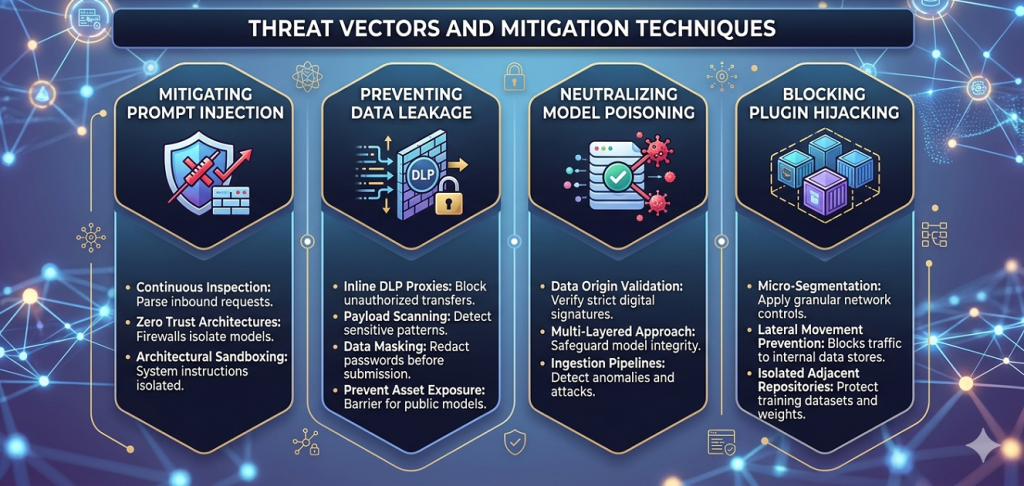
Mitigating Prompt Injection through Continuous Inspection
Attackers often use prompt injection to compromise systems. Zero Trust architectures mitigate these risks by incorporating intelligent application firewalls directly in front of models.
Such firewalls parse the semantic structure of inbound requests. System instructions remain isolated from user inputs through architectural sandboxing. This separation helps maintain the integrity and security of generative AI systems.
Preventing Data Leakage with Inline DLP Proxies
Employees often mistakenly copy internal code into public repositories. Inline data loss prevention utilities block such transfers by scanning outbound payloads for sensitive patterns.
The software can automatically mask sensitive data and passwords before submission. Additionally, this defensive barrier prevents corporate assets from being used to train public models. This mechanism maintains essential generative AI security.
Neutralizing Model Poisoning via Data Origin Validation
Adversarial actors attempt to degrade machine learning performance, often by corrupting training datasets. To mitigate this risk, a verification architecture enforces strict digital signature requirements on all incoming content.
Ingestion pipelines run statistical checks on raw files to detect anomalies. This multi-layered approach safeguards model integrity and generative AI security.
Blocking AI Plugin Hijacking with Micro-Segmentation
Compromised external plugins often attempt lateral movement to access internal data stores. Micro-segmentation mitigates this risk by applying granular network controls to isolated plugin containers. Strict network policies block unauthorized traffic between these containers and internal data stores.
Isolating adjacent data repositories protects critical training datasets and model weights. Such segmentation ensures a plugin-based attack cannot escalate into a system-wide breach.
Conclusion: Securing the Autonomous Future
Zero Trust is not an option anymore but an absolute necessity for AI in the business context. Every prompt, model, and sub-agent should be considered as potential attack vectors. This security approach transforms cybersecurity from being reactive to proactive.
Continuous verification and micro-segmentation are the two strategies with which you can reduce vulnerabilities. Such an approach creates a reliable foundation for Generative AI Security. As a result, enterprises will be able to scale their automation processes safely.
Leave a Reply