
A small SaaS team can move surprisingly fast. One engineer can ship a feature in the morning, answer a customer question after lunch, and fix a production issue before the day ends. That range is part of the appeal of an early startup. It is also where reliability starts to become fragile.
The problem is rarely a lack of effort. Small teams usually work hard. Trouble begins when the product grows faster than the team’s ability to understand and operate it. Every new service, integration, dashboard, and manual process adds another place where something can fail. With only a few engineers, there may be nobody available to investigate when several of those things break at once.
Building a reliable SaaS product with a small team therefore depends less on copying the practices of a large technology company and more on controlling how much complexity the team accepts. The goal is not a perfect system. It is a system where the people in the room can explain, change, and recover when a customer needs them most.
Start with less product
The first reliability decision happens before anyone chooses a database or hosting provider. It happens when the team decides what the product will do.
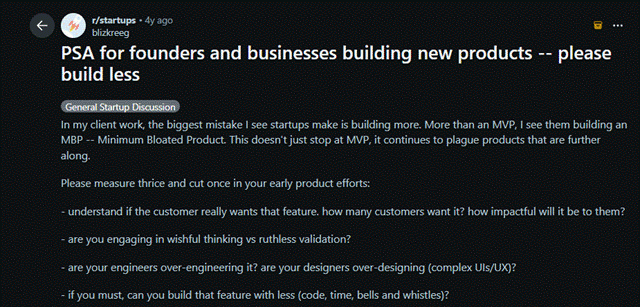
A founder in an r/startups discussion about early product development described a pattern they called the “Minimum Bloated Product”: an MVP weighed down by features that had not been validated. Other founders and engineers in the discussion pointed to the long-term cost. More features meant more code to change, more bugs to find, and more ways for future releases to affect existing customers.
This is easy to underestimate because the cost of a feature does not end when it ships. Someone has to test it, monitor it, answer questions about it, and keep it working when the rest of the product changes. For a team of four, a feature used by a handful of customers can consume time that would have been better spent improving the product’s central workflow.
A small team should be able to state the product’s main job in one sentence. New work should strengthen that job, remove a clear obstacle, or test an important assumption. If it does none of those things, delaying it is often the more responsible engineering decision.
Choose technology the whole team can live with
Founders are often encouraged to prepare for scale from the beginning. Some preparation is sensible. Designing for imaginary scale is different. It can leave a startup operating an architecture built for millions of users while it is still trying to learn why the first hundred should stay.
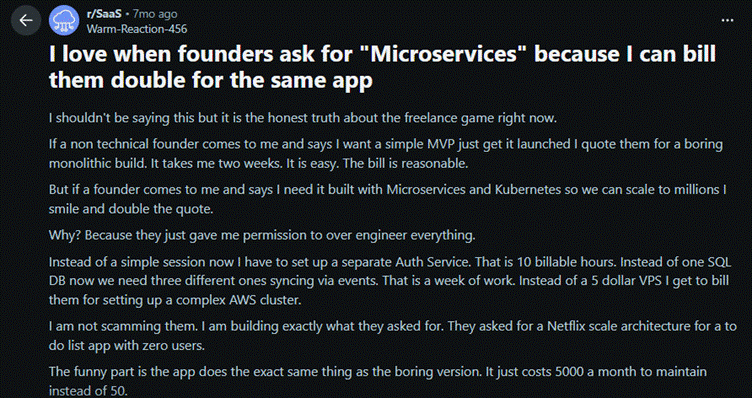
That tension appears regularly in founder communities. In one r/SaaS conversation about premature microservices, developers described early products burdened with multiple services, databases, and orchestration layers before customer demand required them. The examples are personal accounts rather than formal research, but they reflect a practical truth: every architectural boundary creates another relationship the team must observe and debug.
For many young SaaS products, a well-structured application, one primary database, and a small number of dependable managed services are enough. This does not mean ignoring security or writing disposable code. It means choosing an architecture that every engineer can run locally, trace in production, and repair without waiting for the only person who understands it.
The right moment to split a system is when the existing design creates a measured constraint. A service might need to scale independently, a workload may require different security controls, or separate teams may need clear ownership. Until that pressure is real, simplicity gives the startup more room to learn.
Make the path to production boring
A reliable product can still be damaged by an unreliable release. If shipping a change depends on someone remembering a private sequence of commands, the process is already carrying more risk than a small team needs.
The release path should be repeatable. A change enters version control, automated checks run, the application is built the same way each time, and the team can see whether the new version started correctly. If a release fails, the previous working version should be recoverable without reconstructing the incident from memory.
This is where a short, practical baseline helps. Environment variables should hold secrets, database migrations should have an agreed sequence, health checks should confirm that the application is ready, and logs should be available before the first serious incident. This SaaS deployment checklist explains those production basics in more detail.
Research also cautions against assuming that faster coding automatically produces safer releases.
Google Cloud’s 2024 DORA report found that higher AI adoption was associated with improvements in documentation quality, code quality, and review speed. In the same data, it was also associated with a small reduction in delivery throughput and a larger reduction in delivery stability. DORA’s conclusion was measured: AI can help, but teams still need small changes, sound testing, and a stable delivery process.
For a small team, automation should begin with work that is repeated and easy to get wrong. Tests, builds, backups, releases, health checks, and alerts are good candidates. Building a complicated internal platform is usually not. The automation should make the product easier to operate, not create another product the team must maintain.
Protect engineering attention
Reliability suffers when engineers spend their week moving between unrelated problems. A developer who is interrupted by a failed release, an unclear alert, a cloud permission issue, and a customer support request may remain busy all day without improving the product.
The scale of this friction is visible in Atlassian’s 2024 developer experience research. In a survey of more than 2,100 developers and managers, 69 percent of developers said they lost eight or more hours each week to inefficiencies. Developers most often blamed technical debt and weak documentation, while leaders were more likely to point to understaffing and the growing scope of the developer role.
That difference matters for founders. Hiring another engineer may add capacity, but it will not repair a release process that only one person understands. Before expanding the team, look for work that repeats every week. A recurring manual setup, noisy alerts, missing documentation, or overlapping tools may be consuming more time than anyone realizes.
One technical founder on r/SaaS explained why they delayed hiring: before product-market fit, the roadmap changed too often to justify another full-time engineer. The founder expected to hire after demand became clearer. That is only one company’s judgment, but the principle travels well. Add a person when the team can name the continuing responsibility that person will own, not simply because the product feels busy.
Watch costs while the system is still simple
Cloud services let a small company use infrastructure that would once have required a much larger operations team. They can also hide waste until the monthly bill becomes difficult to explain.
Gartner forecast worldwide public-cloud spending of 723.4 billion dollars in 2025, including 208.6 billion dollars for platform services. Gartner also noted that organizations were turning to integrated cloud platforms to simplify development, deployment, and operations. For a startup, the relevant lesson is not the size of the market. It is that buying managed capability has become normal, but each service still needs an owner and a reason to exist.
Cost visibility remains difficult even for experienced organizations. Flexera’s 2025 State of the Cloud report found that 84 percent of respondents saw managing cloud spending as a leading challenge, and respondents estimated that 27 percent of cloud spending was wasted. The survey covered more than 750 cloud professionals and executives, so it should not be treated as a benchmark for early startups. It does show why founders should understand their bill before growth magnifies every inefficient choice.
A small team does not need a formal cost-management department. It needs a monthly habit. Review which services grew, which resources are idle, and whether spending follows customer activity. Assign one person to investigate unusual changes. A ten-minute review performed consistently is more useful than a complicated dashboard nobody opens.
Learn from failures without adding bureaucracy
Incidents will happen. The useful question is whether the team learns enough to prevent the same incident from returning.
After a meaningful failure, write down what customers experienced, how the team noticed, what made recovery difficult, and one change that would reduce the risk next time. The change might be a test, a clearer alert, a documented command, or the removal of a fragile manual step. A small team does not need a ten-page postmortem. It needs an honest record that leads to a specific improvement.
Ownership should also survive holidays and sick days. Every critical part of the product needs a primary owner and at least one other person who can find the documentation, inspect the system, and take the first recovery step. This is less about formal roles than avoiding a product that becomes unmanageable whenever one engineer is unavailable.
Reliability is the ability to keep understanding the product
A small engineering team has an advantage that larger organizations often lose: everyone can still understand most of the product. That shared understanding makes decisions faster and failures easier to diagnose. It should be protected.
Keep the product focused. Choose technology the team can operate. Make releases repeatable. Monitor the few signals that reveal customer impact. Review costs before they become mysterious. When something fails, improve the system instead of relying on someone to remember more next time.
A startup does not need enterprise architecture to behave responsibly. It needs a product whose complexity grows more slowly than the team’s ability to manage it. That is what allows a small group of engineers to keep shipping without making each release feel more dangerous than the last.
Leave a Reply