
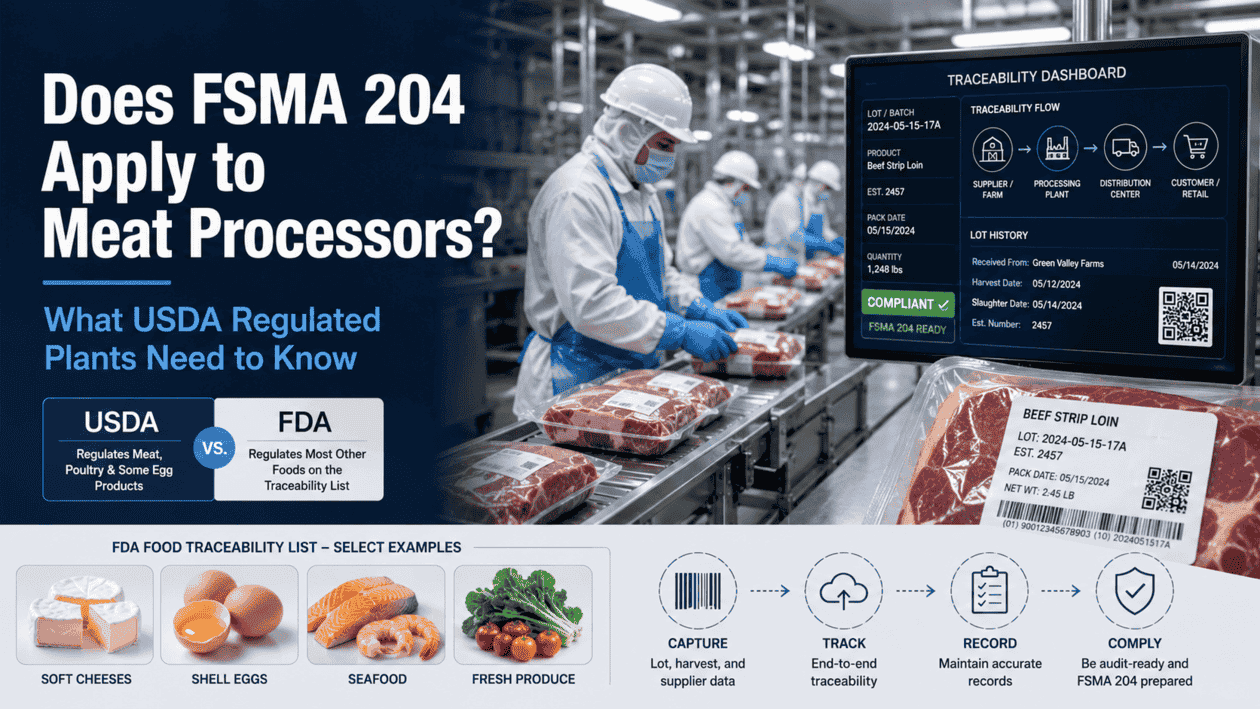
Meat processors keep hearing the same questions from customers, auditors, and even their own compliance teams. Does FSMA 204 apply to us? Do we need traceability lot codes? What happens if the FDA asks for records within 24 hours?
For most USDA-regulated meat and poultry plants, the short answer is that FSMA 204 does not apply to the core meat or poultry product once it sits under exclusive USDA jurisdiction. But that answer changes fast if a plant handles soft cheese, shell eggs, seafood, fresh produce, or any other ingredient on the FDA Food Traceability List, or if it operates as a dual jurisdiction facility.
This is where most articles on the topic stop short. They either explain FSMA 204 in general terms or hand out a blanket “meat is exempt” statement that leaves plant managers exposed. This guide walks through exactly where the exemption starts, where it stops, and what a USDA regulated plant still needs to track even when the rule technically does not apply.
If your plant handles mixed ingredients, value added meat products, or shared receiving workflows, traceability gaps can sit between FDA and USDA record systems without anyone noticing until an audit or recall forces the question. A meat processing ERP that connects receiving, production, quality, and recall records closes that gap before it becomes a problem.
What Is FSMA 204 in Plain Terms?
FSMA 204 is the common name for the FDA Food Traceability Rule, finalized under Section 204 of the Food Safety Modernization Act. It is built around a few core ideas.
The rule applies to foods on the Food Traceability List, a list of foods FDA has identified as carrying a higher risk of contamination and outbreak. It requires covered businesses to keep records for specific points in the supply chain, known as Critical Tracking Events, such as receiving, transforming, and shipping a product. At each of these points, the business must capture Key Data Elements, which are the specific facts (lot codes, quantities, dates, locations) that let investigators trace a product back through the chain. Covered firms must also be able to hand records over to FDA within 24 hours of a request.
The goal behind all of this is speed. When a foodborne illness outbreak happens, investigators need to trace contaminated product back to its source in hours, not weeks. FDA designed the rule to allow for faster identification and rapid removal of potentially contaminated food from the market, which is meant to reduce foodborne illnesses and deaths.
The rule does not apply to every food sold in the United States. It applies specifically to foods on the Food Traceability List and to multi-ingredient foods that contain a listed food as an ingredient, as long as that ingredient is still in the form it appears on the list.
The Short Answer: Does FSMA 204 Apply to Meat Processors?
For most USDA-regulated plants, FSMA 204 does not apply to the core meat or poultry product while it is under exclusive USDA jurisdiction. Businesses that manufacture, process, pack, or hold food on the Food Traceability List while that food is within the exclusive jurisdiction of USDA are exempt from the rule, so those businesses do not need to keep FSMA 204 records for that food.
But the exemption is narrower than most summaries make it sound. FSMA 204 can still apply to a meat processor in several situations:
- The plant receives or holds an FDA listed ingredient before that ingredient enters the USDA controlled side of the facility
- The plant uses a Food Traceability List ingredient, such as soft cheese or shell eggs, in a value added meat product
- The plant operates as a dual jurisdiction facility with both USDA and FDA regulated production lines
- The plant shares receiving rooms, cold storage, or staging areas between FDA and USDA operations
- The plant assembles ready to eat products, such as meat and cheese trays, in a commissary or central kitchen setting
An important piece of this puzzle is how ingredients on the Food Traceability List are received. If a dual jurisdiction facility uses a shared receiving room for all incoming ingredients, it must still maintain Key Data Elements for the listed food, even though that food will eventually become part of a USDA-regulated product. Where the product ends up does not always decide whether records were required at the point it walked through the door.
Why Most USDA Regulated Meat Products Are Outside FSMA 204
FSMA 204 is an FDA rule. The USDA Food Safety and Inspection Service has primary responsibility for regulating meat from species listed in the Federal Meat Inspection Act and the Poultry Products Inspection Act, known as amenable species, which include cattle, sheep, swine, goats, and domestic poultry such as chickens, turkeys, ducks, and geese.
Beef, pork, lamb, goat, and standard poultry products are not general commodity categories on the FDA’s Food Traceability List. The list is built around foods FDA considers higher risk based on outbreak history and contamination patterns, things like soft cheeses, shell eggs, certain seafood, and fresh-cut produce. Core USDA inspected meat and poultry simply are not on it.
A straightforward example makes this clear. A beef processor that slaughters, cuts, packs, and distributes USDA inspected beef is not covered by FSMA 204 for that beef. The product never touches the Food Traceability List, so no Key Data Elements or Critical Tracking Event records are required for it under this rule.
The picture changes the moment that same company also handles an FDA listed ingredient, whether that is soft cheese for a charcuterie tray, shell eggs for a breakfast sausage line, or fresh produce for a value added product. For those ingredients, and for any product where they remain in listed form, FSMA 204 can apply even though the finished product carries a USDA mark of inspection.
FDA vs USDA Jurisdiction: The Thresholds Meat Processors Should Know
Jurisdiction between FDA and USDA is not only about which animal a product came from. It also depends on how much meat or poultry tissue a product actually contains.
FDA and USDA divide primary regulation of meat products made from livestock based on the amount of meat or animal tissue in the product. FDA regulates meat products that contain 3 percent or less raw meat, less than 2 percent cooked meat, or 30 percent or less fat, tallow, or meat extract, alone or in combination. USDA regulates meat products above those thresholds. A similar split applies to poultry products, based on percentages of cooked poultry meat and related tissue. FDA also notes that it may exercise jurisdiction over meat and poultry products that are primarily regulated by USDA when appropriate.
This matters more than it might seem at first glance, because mixed and formulated products can land on either side of the line depending on their recipe.
- A sauce or soup base with a small amount of meat for flavoring may stay under FDA jurisdiction rather than USDA, even though it tastes and reads like a meat product
- A fully formulated, USDA inspected sausage sits squarely under USDA
- A combination product containing cheese, produce, or seafood alongside meat may create separate FDA recordkeeping duties for those specific ingredients, independent of the meat itself
- A facility producing both kinds of product, sometimes on the same line or in the same building, becomes a dual jurisdiction facility with different rules applying to different products and ingredients
For plant managers, the practical takeaway is that jurisdiction is decided product by product and ingredient by ingredient, not by what the company calls itself.
When FSMA 204 Can Still Affect a Meat Processor
This is the part of the rule that gets glossed over in most general FSMA explainers. A few specific situations create real exposure for meat processors, even ones that are mostly USDA regulated.
Dual Jurisdiction Facilities
A dual jurisdiction facility runs both USDA inspected production and FDA regulated production under one roof. This is common in plants that make ready to eat meals, meat and cheese combination products, or value added items that pair USDA meat with FDA regulated ingredients.
FDA has clarified that businesses handling Food Traceability List food while it is under USDA jurisdiction will be exempt from the rule for that portion of the operation. But the exemption only covers the period when the ingredient is genuinely under exclusive USDA control. Before that point, FDA rules can still apply.
Shared Receiving Rooms
This is one of the most overlooked exposure points for meat processors, and it deserves more attention than it usually gets.
If a listed ingredient, such as soft cheese, comes into the plant through a shared receiving area that handles both FDA and USDA bound goods, that receiving event may happen before the ingredient is under exclusive USDA jurisdiction. In that situation, the facility must still maintain Key Data Elements for the listed ingredient at receiving, even if the finished product it ends up in is fully USDA regulated.
In practical terms, FSMA 204 exposure for a meat processor often depends less on what the finished product is and more on where and how an ingredient physically enters the building.
Food Traceability List Ingredients in Meat Products
A handful of FDA listed foods show up regularly in meat industry products, either as standalone retail items or as ingredients in further processed goods:
- Soft cheeses (most cheeses other than hard cheese varieties)
- Shell eggs
- Certain seafood, including finfish, smoked finfish, and crustaceans
- Fresh cut leafy greens
- Fresh cut fruits and vegetables
- Nut butters
- Refrigerated ready to eat deli salads that do not contain meat, poultry, or seafood as the predominant ingredient
FDA’s same form rule means that if one of these ingredients is used in its listed form inside a multi-ingredient product, the finished product is generally covered by the rule as well, unless an exemption such as a kill step applies. A meat processor making a sausage with soft cheese, for example, needs to think about the cheese separately from the meat.
Meat and Cheese Plates, Commissaries, and Ready to Eat Assembly
Commissaries and central kitchens that assemble combination products are a common blind spot. A facility under dual jurisdiction that maintains a shared receiving room for incoming ingredients must keep Key Data Elements for any Food Traceability List food, such as soft cheese, that comes through that room.
A meat and cheese plate is a useful way to picture this. The meat may have a long, clean chain of USDA inspection behind it. That history does not extend to the cheese. If the cheese was never under exclusive USDA jurisdiction at any point, FDA’s recordkeeping requirements for it stand on their own, regardless of what it gets paired with on the plate.
Shipments Into USDA Facilities
The direction product moves between FDA and USDA regulated entities also matters.
When an FDA regulated supplier ships a Food Traceability List food to a facility that is exclusively under USDA jurisdiction, the FDA regulated shipper still has to maintain and send the required shipping Key Data Elements before the handoff happens. Once the product is fully inside USDA jurisdiction, the receiving USDA facility and anyone further down the chain generally do not need to maintain FSMA 204 records for that same product. The recordkeeping obligation sits with whoever shipped it while FDA jurisdiction still applied, not with the USDA plant that received it.
What USDA Plants Still Need Even When FSMA 204 Does Not Apply
It would be a mistake to read all of this as permission to do nothing. A USDA regulated plant that is genuinely outside FSMA 204 scope for its core product still operates under its own demanding set of recordkeeping expectations, and most of them require the same kind of discipline FSMA 204 asks for.
USDA regulated plants still need solid systems for:
- HACCP records and critical control point monitoring
- Sanitation standard operating procedures and logs
- Recall procedures, including documented mock recalls
- Lot traceability from animal intake through finished goods
- Supplier and vendor records
- Label and allergen controls
- Audit retrieval readiness for FSIS and customer audits
- Production and batch genealogy
The underlying question is not really whether FSMA 204 applies. The real question is whether the plant can prove, quickly and accurately, what happened, where it happened, which lots were involved, and which customers received the affected product. That is true whether the request comes from FDA, FSIS, a retail customer, or the plant’s own quality team during an internal investigation.
This is where a meat processing ERP earns its place. Even when FSMA 204 does not apply to a USDA product, processors still need fast lot tracing from animal intake through finished goods dispatch. Folio3 FoodTech’s Meat ERP connects live animal intake, batch lineage, cut yield, cold storage, quality checks, and recall workflows in one system, so teams are not piecing the story together manually under pressure during an audit or a recall.
FSMA 204 Applicability Checklist for Meat Processors
Use this checklist as a quick gut check. If more than one or two answers are unclear, it is worth a closer review of where FDA and USDA jurisdiction actually split inside your plant.
- Do we process only USDA inspected meat or poultry products?
- Do we also manufacture or hold any FDA regulated products at the same facility?
- Do we use any Food Traceability List ingredients, such as soft cheese, shell eggs, or seafood?
- Are listed ingredients received through a shared receiving room rather than a dedicated USDA only area?
- Are our FDA and USDA operations physically separated, with clear handoff points?
- Do listed ingredients move fully into USDA jurisdiction immediately after receiving, or do they sit in a shared space first?
- Do we assemble meat and cheese trays or other ready to eat combination products?
- Do we ship listed foods to other facilities before those foods enter USDA jurisdiction?
- Could we retrieve the relevant lot and receiving records within 24 hours if FDA requested them?
- Can we trace an affected lot from receiving all the way through to the customers who received it?
If your team cannot answer these quickly and with confidence, that is a sign the plant’s traceability process needs a closer look, independent of whether FSMA 204 technically applies.
What Data Should Meat Processors Track Even If They Are Mostly Exempt?
Whether or not FSMA 204 covers a given product, the underlying data set that protects a meat processor during a recall or audit looks remarkably similar. At minimum, plants should be able to track:
- Supplier name and ingredient source
- Receiving date and location
- Lot code, and traceability lot code where one applies
- Processing zone or production area
- Batch or formulation record
- Each product transformation step
- Finished goods lot
- Storage location and movement history
- Shipment date
- Customer or distribution destination
- Quality holds and their resolution
- Corrective actions taken
- Recall status, if applicable
- Allergen linkage
- Cold chain data, including temperature history
A meat ERP system is the practical control layer for this kind of data. It is worth framing it correctly, though. This is not FSMA 204 software specifically. It is a meat processing ERP that happens to support the traceability, recall readiness, lot genealogy, production control, yield management, and compliance reporting that good practice already demands, regardless of which regulation is technically in play.
Why Spreadsheets Are Risky for FSMA 204 Edge Cases
Spreadsheets and paper logs can work fine for a single product line in a single jurisdiction. They tend to fall apart exactly where FSMA 204 edge cases live, which is at the boundary between systems.
Common failure points include:
- Receiving records are kept separately from production records, so nobody can quickly connect an ingredient lot to the batch it went into
- USDA and FDA-related records are stored in entirely different systems or formats
- Ingredient lots that are never formally tied to the finished goods they end up in
- Quality is updated manually, with no automatic link back to the affected inventory
- Recall teams are forced to search through emails, paper logs, and disconnected spreadsheets under time pressure
- Multiple plants use different naming conventions for the same kind of record
- Lot codes that exist in production but are never connected to the customer shipments they went out in
Each of these gaps is manageable in isolation. Stacked together, especially in a dual jurisdiction facility, they turn a routine audit or recall into a slow, stressful scramble. A meat ERP system reduces this risk by linking procurement, receiving, production, quality, inventory, distribution, and recall records into one connected workflow rather than a collection of separate files. Folio3 FoodTech covers how this works in practice, from end to end lot tracking and batch traceability to catch weight handling, quality checks, food recall management, and compliance reporting.
How Meat ERP Helps USDA Plants Stay Audit Ready
Lot Tracking From Receiving to Dispatch
A connected ERP ties ingredient lots, animal intake records, production batches, and finished goods lots together automatically as product moves through the plant. That connection is what makes it possible to answer a tracing question in minutes rather than days, whether the question comes from FDA, FSIS, or a retail customer.
Batch Lineage for Ground, Blended, and Value Added Meat
Products like sausage, patties, marinated cuts, cooked meats, and deli items often combine multiple ingredient lots into a single batch. Strong batch lineage tracking keeps that history intact, so a single contaminated ingredient lot can be traced to every finished batch it touched, not just the most obvious one.
Recall Management and Impact Analysis
When a recall question comes up, speed depends on having the answer already connected rather than having to build it from scratch. ERP backed recall workflows help a plant identify affected lots, current inventory on hand, which customers received shipments, and the realistic scope of the recall, all from existing data rather than a manual investigation.
Quality and Food Safety Records
Pathogen testing results, quality holds, corrective actions, supplier approvals, inspection logs, and release status all need to be retrievable quickly during an audit. Keeping these tied to the same lot and batch records used for production means quality data does not live in a separate silo from everything else.
Catch Weight and Yield Visibility
Compliance and operations are not separate concerns in a meat plant. Catch weight handling and yield visibility affect pricing accuracy and margin just as much as they affect traceability. Connecting these to the same system that handles compliance records makes the case for ERP investment stronger across finance, operations, and quality teams, not just the compliance department.
Common Misconceptions About FSMA 204 and Meat Processing
Misconception: All meat processors are covered by FSMA 204. This is not accurate. Most USDA regulated meat and poultry products are not covered while they remain under exclusive USDA jurisdiction.
Misconception: No meat processor needs to think about FSMA 204 at all. This is also wrong. Dual jurisdiction facilities, shared receiving rooms, listed ingredients, and mixed product operations can all create real recordkeeping duties, even for a primarily USDA regulated plant.
Misconception: If the finished product is USDA regulated, every upstream record is automatically exempt. The soft cheese and sausage example shows why this does not hold up. Receiving records for a listed ingredient may still be required depending on exactly where and how that ingredient entered the facility, regardless of what it eventually becomes part of.
Misconception: The only goal here is satisfying FDA. Even a USDA plant with no FSMA 204 exposure at all still needs strong traceability for its own recalls, for FSIS audits, for retailer requirements, and for internal quality control. Good traceability is not a compliance checkbox. It is operational insurance.
Frequently Asked Questions
Does FSMA 204 apply to USDA regulated meat processors? Usually not, for products that stay under exclusive USDA jurisdiction throughout processing. It can still apply to FDA listed foods handled before USDA jurisdiction begins, or in shared areas that are not under exclusive USDA control.
Is beef, pork, lamb, or poultry on the Food Traceability List? No, not as general commodity categories. The rule focuses on specific foods listed on FDA’s Food Traceability List, along with listed ingredients that remain in their listed form when used in another product.
Does FSMA 204 apply if a sausage contains soft cheese? It depends on where and how the soft cheese is received. If the cheese enters through a shared receiving room that is not under exclusive USDA jurisdiction, receiving Key Data Elements may still be required for it, even though the finished sausage is USDA regulated.
Does a USDA plant need to keep FSMA 204 records for listed foods shipped to it? The FDA regulated shipper is generally responsible for maintaining and sending the required shipping Key Data Elements before the product reaches the USDA facility. Once a food is genuinely within exclusive USDA jurisdiction, the receiving USDA plant and later handlers typically do not need to maintain separate FSMA 204 records for it.
What is the current FSMA 204 compliance date? The original compliance date was January 20, 2026. FDA announced in March 2025 that it intended to extend that date by 30 months, moving the compliance deadline to July 20, 2028. The core requirements of the rule were not changed by this extension, only the enforcement timeline.
Do meat processors still need traceability software if FSMA 204 does not apply to them? Yes, in most cases. Faster recall response, batch lineage, quality recordkeeping, lot control, and audit retrieval are operational needs on their own, driven by USDA requirements, retailer demands, and internal food safety standards, independent of whether FSMA 204 specifically applies.
Leave a Reply