
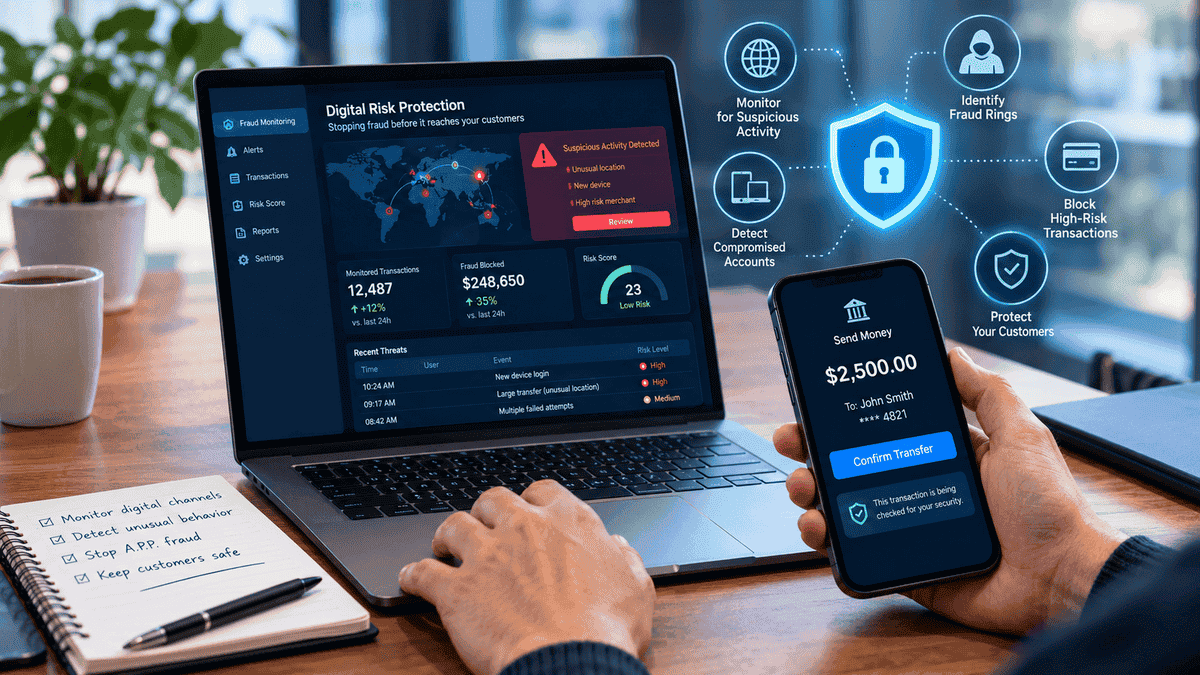
Authorized push payment fraud is the fastest-growing scam category targeting US and international real-time payment rails. The customer is the one who moves the money, tricked by a convincing pretext, so the fraud does not trigger any of the classic unauthorized-transaction alerts. Once the payment lands, funds are broken up and moved through mule networks within minutes.
Digital risk protection changes the economics of this fraud category by attacking the scam infrastructure before the customer is ever contacted. When phishing sites, impersonation profiles, spoofed mobile apps, and malicious ads are taken down at scale, the volume of successful pretexts drops, and so does the loss rate.
Why authorized push payment fraud defeats transaction monitoring
Authorized push payment fraud defeats transaction monitoring because the customer authenticates the payment. Every risk signal that transaction monitoring relies on, from device recognition to session behavior to authentication strength, comes back clean. The fraud happens upstream of the payment, in the conversation, the fake website, or the impersonated app that convinced the customer to send the money in the first place.
Real-time payment rails compound the problem. Once the transfer settles, there is no unwind window and no chargeback mechanism. Recovery depends entirely on the receiving institution’s ability to freeze funds before the mule cashes out, and mules move fast.
The scam infrastructure behind authorized push payment fraud
Almost every authorized push payment scam starts with a piece of digital infrastructure the fraud team can see and disrupt. Phishing sites impersonate the bank, the tax authority, a delivery service, or a utility. Fake mobile apps mimic the customer’s real banking app or a fake investment platform. Impersonation profiles on LinkedIn, WhatsApp, Telegram, and social media platforms pose as bank staff or executives. Malicious ads on search engines and social platforms direct victims to lookalike sites at the moment they are searching for help.
This infrastructure has to exist for the scam to work. Every domain the fraud team removes, every fake app the fraud team gets delisted, and every impersonation account the fraud team takes down is a scam pipeline that goes cold before the victim ever sees it.
How Group-IB Digital Risk Protection disrupts the pipeline
Group-IB Digital Risk Protection covers the surface web, dark web, mobile app stores, social platforms, and paid ad ecosystems in one system. AI-driven detection surfaces phishing sites within hours of registration, catches fake mobile apps as they land in official and third-party stores, identifies executive and staff impersonation across social channels, and monitors sponsored ads for lookalike creative.
The takedown side is where the pipeline gets disrupted. Group-IB’s CERT-GIB team handles the removal workflow directly with registrars, hosting providers, mobile app stores, social platforms, and ad networks. Group-IB is one of the few providers that runs takedowns as an integrated part of the product rather than as an outsourced afterthought, and the takedown volume shows in the numbers reported in Group-IB’s Digital Risk Highlights series.
Multi-language coverage for authorized push payment scams
US institutions with international customer bases or overseas remittance corridors face authorized push payment scams in multiple languages. Group-IB’s detection and takedown coverage runs across English, Arabic, Russian, Spanish, and a wide set of CIS and APAC languages, which matters because scam infrastructure operators pick languages where they think detection is weak.
This coverage is particularly relevant for institutions serving diaspora communities, cross-border payment corridors, and correspondent banking flows, all of which are heavily targeted by localized authorized push payment campaigns.
Operationalizing digital risk signals inside the fraud workflow
The most effective operating model combines Group-IB Digital Risk Protection signals with the institution’s own fraud detection and customer communication workflows. When a new phishing domain targeting the bank is detected, the fraud team can preemptively add the domain to transaction monitoring rules, alert customer service to expect calls from confused customers, and issue targeted awareness messages to segments most likely to be hit. This turns detection into prevention.
The reactive path matters too. When a customer calls in after being scammed, having the takedown infrastructure already in place means the specific phishing site or fake app can be removed within hours rather than days, limiting how many more customers are hit before it goes dark.
Building the business case
The business case for digital risk protection against authorized push payment fraud comes down to three numbers. The average loss per authorized push payment case, which in the US commonly runs from four to six figures depending on segment. The volume of infrastructure attributable to campaigns targeting the institution, which Group-IB can baseline in the first thirty days. And the takedown latency, which determines how many customers see the scam site before it goes down.
Fraud leaders can request a Group-IB baseline scan to see how much scam infrastructure is currently active against their brand and what the takedown volume would look like in the first ninety days of the program.
Leave a Reply