
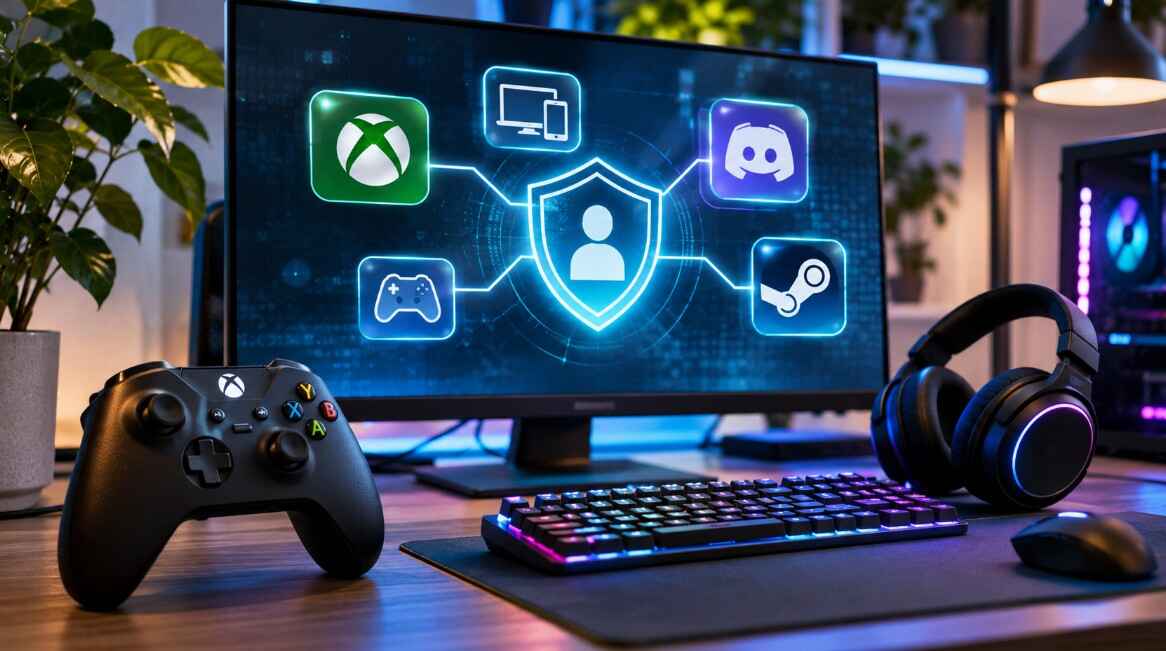
For millions of gamers, an online identity begins with a simple decision: choosing a username. Yet that name increasingly has to work across an interconnected collection of consoles, PC gaming services, communication platforms and streaming communities.
Someone might begin playing on Xbox, join friends through Discord, purchase games on Steam and eventually start sharing gameplay on Twitch. Although these services support overlapping communities, they don’t necessarily share the same naming rules, identity systems or account management features.
What initially looks like a straightforward personalisation choice has become a surprisingly complicated digital identity challenge.
And as gaming becomes more connected, both players and technology companies have important questions to consider about consistency, security and ownership.
Gaming Has Outgrown the Single-Platform Identity
There was a time when a player’s online identity was largely confined to one gaming ecosystem.
An Xbox Live gamertag identified someone within Microsoft’s gaming network, while a PlayStation Network account provided a separate identity for Sony’s console community.
PC players developed their own profiles through services such as Steam.
Today, those distinctions still exist, but gaming communities increasingly extend beyond individual platforms.
Cross-platform multiplayer allows friends using different hardware to compete or cooperate in supported games. Discord brings gaming communities together outside their original platforms, while streaming services allow audiences to follow creators regardless of where they play.
The result is a more connected experience for players, but not necessarily a unified identity system.
A player may use one name on Xbox, another on PlayStation and a slightly modified version on Discord because their preferred username is unavailable.
For casual gaming, this might be a minor inconvenience. For streamers, esports competitors and community organisers, however, inconsistent identities can make recognition more difficult.
The challenge is finding a practical balance between creative freedom, platform requirements and the need to establish a recognisable online presence.
Different Platforms, Different Naming Rules
One of the biggest obstacles to maintaining a consistent gaming identity is that major platforms approach usernames differently.
Microsoft’s modern Xbox gamertag system, for example, allows players to select names that may already be in use.
Rather than requiring every visible name to be completely unique, the system can assign a numerical suffix to distinguish accounts.
Microsoft’s official developer documentation explains how modern gamertags separate the chosen name from its identifying suffix.
A modern Xbox gamertag supports up to 12 characters in the chosen name before any suffix, while the complete unique identifier includes the suffix when one is needed.
PlayStation takes a different approach.
Each player has a unique online ID, and changing that identity involves a formal account management process.
According to PlayStation’s support documentation, the first online ID change is free, with charges applying to subsequent changes.
Sony also warns that changing an online ID can cause compatibility issues with certain older games.
Discord introduces another distinction between an account’s unique username and its public-facing display name.
Under Discord’s username system, usernames must be unique, use lowercase characters and follow specific formatting requirements. Display names are more flexible and don’t need to be unique.
For players establishing a new community identity, exploring creative Discord name ideas can help them find something memorable and appropriate for their gaming interests. The chosen username must still comply with Discord’s requirements and be available on the platform.
Steam separates account identifiers from public profile names, too. Its support documentation explains that account names and SteamIDs cannot be changed, while public player names can be updated through profile settings.
These differences illustrate a fundamental issue: the name players see isn’t always the identifier that the platform uses internally.
The Technical Difference Between Identity and Appearance
From a software perspective, gaming identity involves several different layers.
An account identifier provides a persistent reference to a particular user within a service.
A username may be used for account discovery, sign-in or identification, depending on the platform.
A display name, meanwhile, is often designed primarily for social interaction and personal expression.
These concepts can overlap, but treating them as interchangeable creates problems.
Consider what happens when someone changes their public-facing name.
Their friends may need to recognise the updated identity, but their purchases, achievements, permissions and account history should remain associated with the same underlying account.
This is why stable identifiers matter.
Rather than relying exclusively on the characters displayed in a username, well-designed systems can associate account data with identifiers that remain consistent when public names change.
For developers building multiplayer games or community applications, the distinction is particularly important.
Using a mutable display name as the sole reference for an account can introduce unnecessary complications if that name changes or is shared by multiple people.
The same principle applies to moderation systems, player records and account integrations.
A reliable digital identity system must support personalisation without compromising account continuity.
Why Naming Consistency Matters to Players
Technical identifiers may keep account systems functioning, but ordinary players are more concerned with how others recognise them.
Imagine a player who uses the name ShadowViper on Xbox.
They subsequently discover that the same name is unavailable on Discord and PlayStation.
They might choose ShadowViperUK on one platform and ShadowViperGaming on another.
These variations are understandable, but they create small obstacles when someone attempts to find or identify the same person across different services.
A recognisable name can make several everyday activities easier, including locating friends, participating in communities and sharing gaming content.
For creators, consistency becomes even more valuable.
A streamer whose name closely matches their gaming profiles gives viewers a clearer connection between the content they watch and the person they might encounter in-game.
However, maintaining that consistency isn’t always easy when usernames have different character limits and availability requirements.
Creative tools can provide a useful starting point. For example, GamerBolt’s gamertag creation tool allows players to experiment with different gaming names and styles before choosing an identity.
Such tools are useful for brainstorming, although suggested names still need to be checked against each platform’s rules and availability requirements.
The objective isn’t necessarily to secure exactly the same name everywhere. Sometimes a recognisable variation is the more practical solution.
Account Linking Isn’t the Same as Having One Identity
Another source of confusion is the difference between linking accounts and genuinely unifying them.
Many gaming services allow players to connect accounts from other platforms.
This might enable particular social features, facilitate account-based integrations or provide access to supported cross-platform functionality.
However, linking an Xbox account to another service doesn’t automatically give both accounts the same username, permissions or identity structure.
Each platform continues operating its own account system.
This separation has advantages.
Companies can maintain independent security controls, manage their own communities and enforce platform-specific policies.
It also introduces complexity.
Players may need to manage several passwords, authentication methods, privacy settings and account recovery procedures.
The more connected the services become, the more important it is for users to understand exactly what information and permissions they’re sharing.
For technology companies, account linking therefore represents both an opportunity to improve convenience and a responsibility to communicate how those integrations operate.
The Security Risks of a Recognisable Online Identity
Consistency makes gaming identities easier to recognise, but visibility can introduce risks.
A well-known username may attract impersonation attempts, particularly when associated with a popular streamer, community administrator or competitive player.
Someone might create an account using a visually similar name and attempt to convince other users that they’re the genuine creator.
Display names make this issue especially relevant.
On platforms where display names aren’t unique, two accounts can appear similar without belonging to the same person.
This is why users should avoid treating a familiar display name as definitive proof of identity.
Checking the underlying account, official profile links and relevant verification information provides a stronger basis for recognising legitimate accounts.
Security also extends beyond impersonation.
Players should use unique passwords, enable available multifactor authentication and exercise caution when following account-linking requests from unfamiliar websites.
Sharing too much personal information within a username can create additional privacy concerns.
A gaming identity should be memorable without revealing details such as a home address, full date of birth or private contact information.
For creators building substantial audiences, separating public gaming identities from sensitive personal information becomes particularly important.
What Gaming Platforms Can Learn From Each Other
The differences between Xbox, PlayStation, Steam and Discord highlight several competing priorities.
Some systems prioritise unique identifiers that make accounts straightforward to distinguish.
Others provide flexible display names to support personal expression.
Microsoft’s modern gamertag system demonstrates one approach to allowing similar visible names while preserving unique identifiers through suffixes.
Discord’s separation of usernames and display names represents another way to balance account identification with creative freedom.
Neither model completely eliminates the challenges of cross-platform identity.
Nevertheless, they show how thoughtful account design can make the experience more manageable.
For developers and technology businesses, several principles are worth considering:
- Separate stable identifiers from changeable names. Account records should not depend entirely on a public label that users may update.
- Make identity changes understandable. Explain what happens when usernames change and whether previous names remain visible.
- Support clear account verification. Give communities practical ways to distinguish authentic profiles from impersonators.
- Design for cross-platform compatibility. Consider how names, character sets and identifiers behave when information moves between different services.
- Prioritise user control. Provide understandable privacy settings, account recovery procedures and security options.
These principles are relevant beyond gaming.
Social networks, collaborative software and online marketplaces face many of the same questions about identity, recognition and account continuity.
Could Gaming Ever Have a Universal Identity System?
The idea of carrying one persistent digital identity across every gaming platform is appealing.
Players could theoretically maintain a single recognisable profile while moving between games, devices and communities.
Yet implementing such a system would involve considerably more than standardising usernames.
Companies would need to address interoperability, privacy, moderation, ownership, authentication and the handling of account information across organisational boundaries.
A universal identifier might simplify certain interactions, but it could also make it easier to associate someone’s activity across services without their consent.
That introduces legitimate privacy considerations.
There is also the issue of control. A single organisation managing identity for numerous services could create an undesirable dependency, while a decentralised approach would require participating platforms to agree on technical standards and trust relationships.
A more realistic direction may involve improving interoperability while allowing platforms to retain their independent account systems.
In that model, players would have better ways to connect and verify their identities without surrendering control over every aspect of their online presence.
The Future of Gaming Identity Is About More Than Usernames
Online gaming has evolved into a complex network of communities, services and digital experiences.
Players increasingly move between ecosystems that were originally designed to operate independently.
Their public identities often travel with them socially, even when the underlying accounts remain separate.
For individuals, the challenge is choosing a recognisable identity, maintaining consistency where practical and protecting their accounts.
For technology companies, the challenge is considerably broader: creating systems that support personal expression while preserving security, privacy and reliable account management.
As cross-platform gaming continues to develop, these considerations are likely to become more significant.
The humble gamertag may appear to be a small part of the gaming experience, but it sits at the intersection of identity, technology and online community.
The next stage of connected gaming won’t simply be about allowing people on different devices to play together. It will also be about helping them recognise, connect with and trust one another across digital platforms.
Leave a Reply