
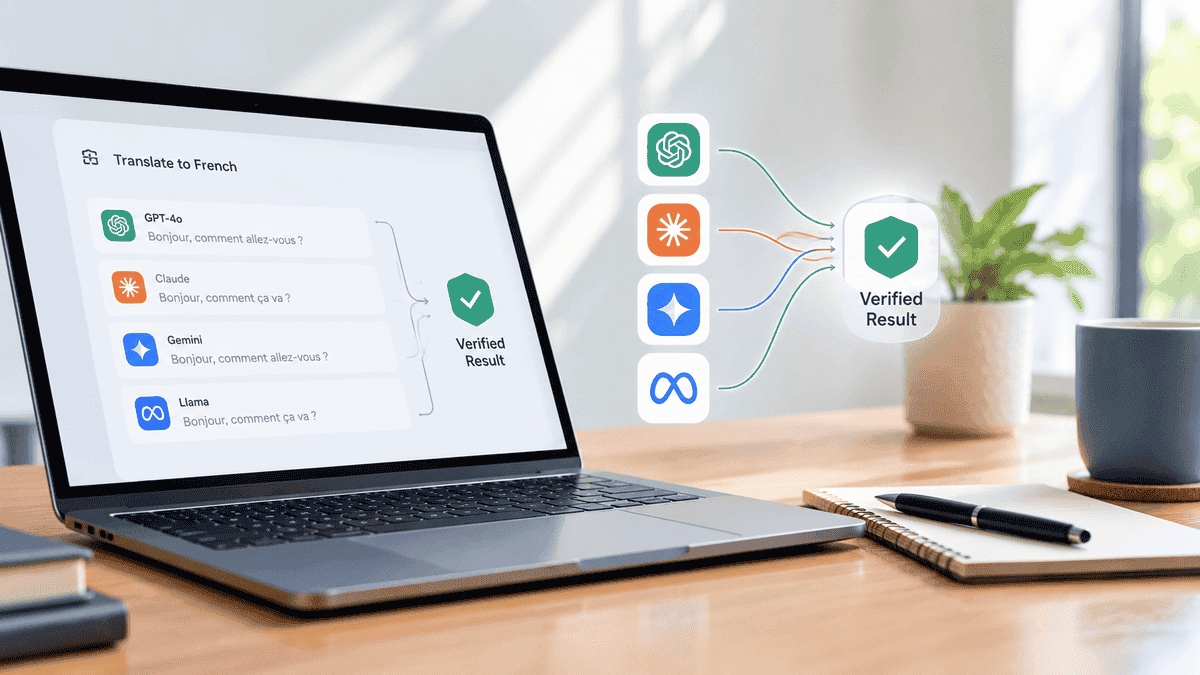
For the last two years, most enterprise teams treated AI translation the way they treated spellcheck: run the text through one model, accept the output, move on. That approach is losing ground fast. As legal, procurement, and compliance teams push more contracts, filings, and customer-facing content through AI translation, a harder question has surfaced: what happens when the model gets it wrong, and nobody catches it before it ships?
The stakes are highest in legal and contractual language, where a single mistranslated term can shift enforceability, jurisdiction, or liability. A binding arbitration clause is a useful stress test: it is dense, formulaic, and unforgiving of imprecision, which is exactly why it tends to expose where AI models disagree with each other. an example of how AI handles a binding arbitration clause shows how much a rendering can shift between models on a single clause, and why enterprise buyers are no longer comfortable trusting the first output they see.
The data backs up the discomfort. Machine-assisted translation now powers a majority of enterprise language workflows, but volume has outpaced verification. IBM’s 2025 AI Adoption Index found that 39% of AI-powered customer service bots were pulled back or reworked in 2024 because of hallucination-related errors. Nimdzi’s 2025 buyer research goes further, naming consistency across translated content as a persistent, unresolved concern tied to the stochastic nature of generative AI, the same source text can produce meaningfully different output from the same model on different runs, let alone across different models.
That variability is pushing enterprise buyers toward a different architecture entirely. Instead of asking “which AI model is best,” procurement and localization leads are now asking “what happens when the models disagree, and who sees it.” The emerging standard runs source text through several leading models in parallel, flags where their outputs converge, and treats disagreement itself as a risk signal rather than something to paper over. A translation that every model agrees on carries a different level of confidence than one where the models split, and until recently, buyers had no way to see that difference at all.
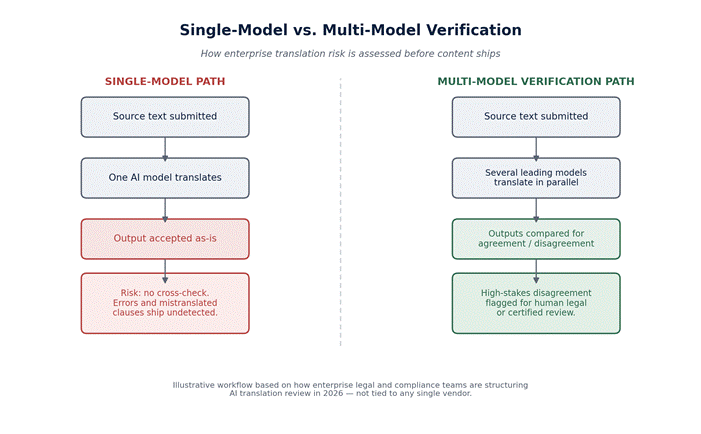
How enterprise teams are restructuring AI translation review in 2026.
The most telling data point is on consistency at scale, not just accuracy on a single sentence. Internal benchmarking by Tomedes, a professional translation company, found that consensus-checked output maintained terminology and register consistency above 96% across multi-document enterprise workflows, compared to an industry baseline closer to 78% for single-model output at equivalent volume. “The failure mode we see most often isn’t one dramatic mistranslation,” says Rachelle Garcia, an AI lead who has worked on multi-model translation systems. “It’s slow terminology drift across a thousand-document contract set, where nobody notices until a client or a regulator does.”
For the highest-stakes categories, court filings, regulatory submissions, sworn records, enterprise teams are layering a human review step on top of model consensus rather than treating AI output as final in either direction. The logic mirrors how engineering teams handle automated testing: automation narrows the field of likely errors, but a qualified human still signs off before anything ships to a court, a regulator, or a client.
What This Means for Enterprise Buyers
Teams evaluating AI translation vendors in 2026 are increasingly asking a short list of questions that would have sounded unusual two years ago:
- Does the platform show you where models agree and disagree, or only the final output?
- Is there a defined escalation path to a certified human reviewer for legal, medical, or regulatory content?
- Can the vendor demonstrate consistency across a large document set, not just accuracy on a sample sentence?
- Is the original formatting, clause numbering, headers, signature blocks, preserved, or does the document need to be rebuilt after translation?
None of this makes single-model AI translation useless, for low-stakes, high-volume content, speed still wins. But for the categories where a wrong word creates real liability, the direction of travel is clear: enterprise buyers are no longer asking which model to trust. They are asking how to verify the one they get.
Leave a Reply