
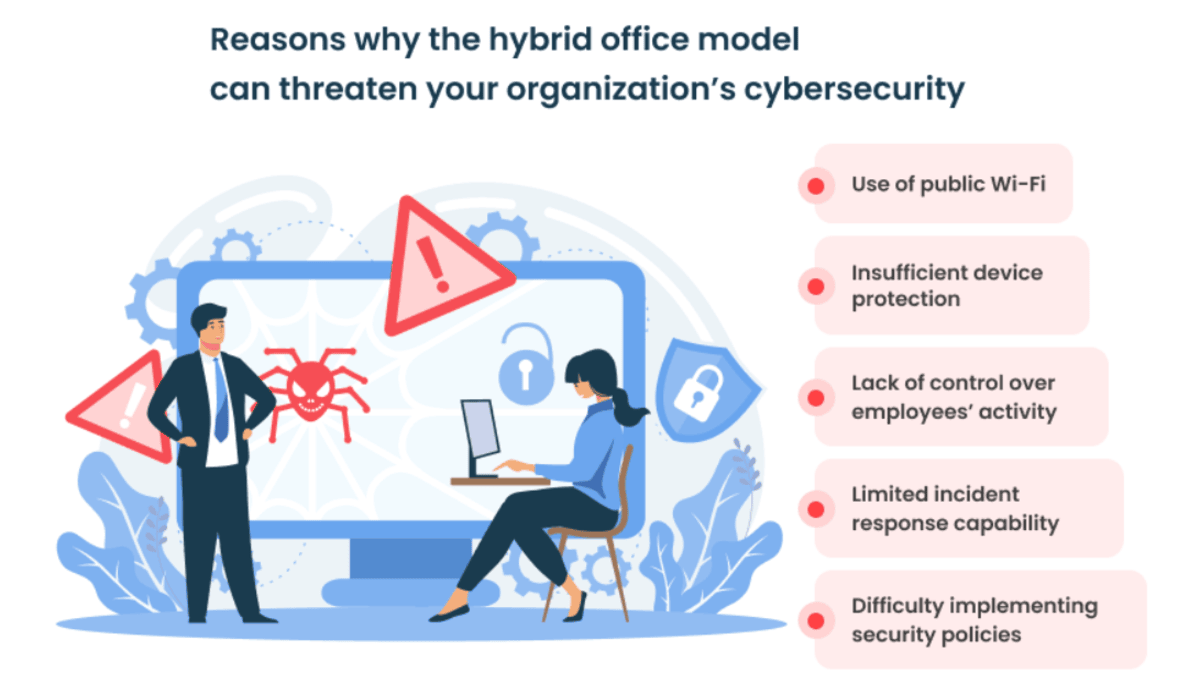
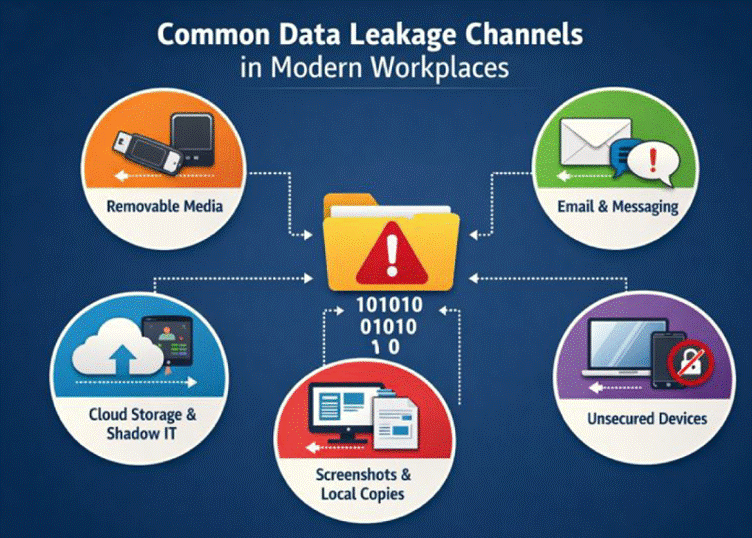
Data does not disappear the way it used to. It leaves through a personal USB drive plugged in at home. It leaves through a cloud upload to a tool IT never approved. It leaves through a home network that nobody hardened, and a decision an employee made on a Friday afternoon without realizing what they were doing. In a hybrid work environment, every one of those exit points multiplies. Most organizations are still managing them with policies written for a world where everyone sat in the same building under the same roof.
According to IBM’s Cost of a Data Breach Report, the average data breach is now $4.4 million. The risks are real in hybrid work environments as well. Most of them are also addressable once you know where to look.
Assessing Your Organization’s Data Loss Exposure
Before buying tools or rewriting policies, the more valuable first step is understanding where your exposure actually lives. Most organizations discover the answer looks different from what they assumed.
Start by mapping which employees access sensitive data and from where. A finance team member at home on an unmanaged laptop accessing payroll systems carries a fundamentally different risk profile than a designer pulling files from a shared creative folder. Hybrid work security starts with that level of specificity, not broad assumptions about the workforce.
Work through these questions across each department:
- Which data types get accessed remotely, and by whom?
- What devices are being used, and does the organization manage them?
- Which cloud services are employees using without IT approval?
- Where do data transfers happen outside monitored channels?
The answers surface data protection strategies built around actual exposure rather than theoretical risk. Remote workforce security cannot come from a generic template.
Building a Security-Aware Workforce
Technology cannot cover the gaps that human behavior creates. An employee who understands why data protection matters makes better decisions in the grey areas that no policy document fully anticipates. Those grey areas appear constantly in hybrid environments, and they are where most incidents start.
Effective security awareness training is not an annual compliance video that employees click through to confirm they watched. It needs to be ongoing, specific, and connected to situations people actually encounter. Walk teams through concrete scenarios. What does a phishing attempt targeting remote workers actually look like right now? What should someone do when they are unsure whether a file transfer is appropriate?
The goal is not fear. It is judgment. Organizations that build genuine security literacy reduce data loss risks because employees start catching potential incidents themselves rather than waiting for IT to notice something weeks later.
Strengthening Endpoint Security
In a hybrid environment, the endpoint is where the organization meets every possible threat. The laptop someone carries between their kitchen table and their office desk. The phone connected to a home network one day and a coffee shop network the next. Protecting it is not optional.
Endpoint data loss prevention solution monitors and controls how data moves at the device level. It tracks which files are being copied, where they are going, which applications are touching sensitive directories, and whether external storage is being used outside policy. For organizations where employees switch between home and office networks throughout the week, endpoint-level control is the only protection that travels with the device, regardless of where it connects.
Foundational endpoint security measures for hybrid work:
- Encryption on all devices accessing organizational data
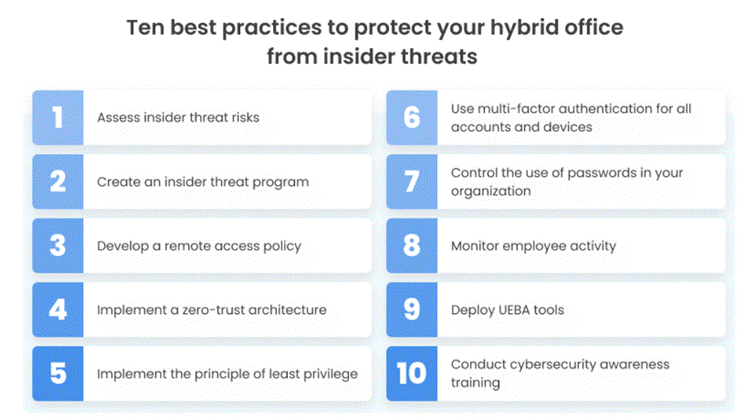
- Multi-factor authentication on every system handling sensitive information
- USB and removable media controls block unauthorized transfers at the hardware level
- VPN enforcement for employees accessing internal systems remotely
Organizations maximize the digital safety layer by implementing these controls before adding anything more sophisticated on top.
Using Data Loss Prevention Solutions
Modern Data loss prevention tools identify sensitive data and enforce rules around how it can move, who can share it, and where it can go. In practice, a DLP solution can block an employee from emailing a file containing customer payment data to a personal address, even from a home network sitting outside the corporate perimeter.
DLP solutions cover email, cloud storage, messaging platforms, and endpoint devices simultaneously. They classify data automatically based on content patterns, recognizing what looks like a credit card number, a health record, or a confidential contract without manual tagging.
For hybrid teams, the capability that matters most is whether the tool functions consistently regardless of the network. A policy that only enforces when an employee connects to the office network is not a hybrid work security policy. It is an office policy with predictable gaps.
Monitoring and Detecting Suspicious Activity
Not every data loss incident is accidental. Insider threat prevention requires catching unusual behavior before data leaves rather than piecing together what happened after it already has.
Behavioral monitoring tools establish a baseline for each employee, which systems they access, at what times, and in what volumes, then flag deviations worth investigating. An employee who has never touched the contracts folder suddenly downloading its entire contents on a Thursday evening is a signal. A team member sending an unusually high volume of external emails in the days before their notice period ends is another. Real-time monitoring makes it possible to act on those signals rather than discover them retrospectively.
One implementation point matters more than the rest. Employees should know what is monitored, why, and how that data gets used. Teams that understand monitoring as an operational tool rather than covert surveillance adopt it without resistance and cooperate when something needs investigating.
Build the Habit Before You Need the Incident Response Plan
Organizations that consistently reduce data loss risks in hybrid environments share one characteristic. They treat security as an operational discipline rather than an IT project that runs parallel to the real work. The tools matter. The policies matter. The habits employees develop around how they handle data on an ordinary Tuesday matter more than either.
Start with the exposure assessment. Build awareness from there. Layer in endpoint and DLP controls that enforce what policy alone cannot. The organizations that do this work before an incident find it significantly less expensive than the ones that do it in response to one.
For real-time access to cybersecurity news, breach reports, and emerging threat intelligence, The Tech Leaders provides coverage across verified global sources. Keep your security team informed and ahead of what is changing at thetechleaders.com.
Author’s: Charu is an outreach specialist with over 4 years of experience in digital marketing. Her expertise lies in developing and executing outreach campaigns that drive engagement and build brand awareness. When she’s not brainstorming outreach ideas, you can find Charu exploring the outdoors or practicing yoga.
Leave a Reply