
Running a successful orthodontic practice requires more than just clinical excellence. You might be the best provider of Invisalign or traditional braces in your city, but that expertise means little if potential patients cannot find you.
The digital landscape has shifted how patients select healthcare providers. They no longer rely solely on referrals from general dentists; they turn to Google.
If your practice isn’t appearing in the top results when someone searches for “orthodontist near me,” you are effectively invisible to a large segment of your market.
This is where SEO for orthodontists becomes critical. It is the bridge connecting your clinical skills with the patients who need them.
To help you navigate this complex field, we are reviewing the strategies championed by experts such as Justin Morgan, widely known as the “Dental Marketing Guy.” Morgan has spent years demystifying the algorithms that dictate online visibility for dental professionals.
By focusing on specific, actionable strategies, he has helped countless practices move from obscurity to the top of the search results.
This guide explores ten essential SEO tips, tailored specifically for orthodontists. These aren’t generic marketing hacks; they are foundational elements of a robust digital presence designed to drive organic traffic and, ultimately, new patient starts.
1. Master Local Keyword Research
The foundation of any successful SEO campaign is understanding what your potential patients are actually typing into the search bar. For orthodontists, the intent is almost always local.
A user in Chicago isn’t just looking for “braces”; they are looking for “braces Chicago” or “best orthodontist in Lincoln Park.”
Your keyword strategy must pivot away from broad, high-competition terms and toward specific, high-intent local phrases.
Tools such as Google Keyword Planner, Ahrefs, and SEMrush can help you identify these terms. Look for keywords that indicate a readiness to book an appointment, such as:
- “Invisalign cost [Your City]”
- “Adult braces near me”
- “Emergency orthodontist [Your Zip Code]”
- “Pediatric orthodontist reviews”
Don’t ignore question-based keywords. Voice search is becoming increasingly prevalent, and people often ask their devices specific questions like, “How long do braces take?” or “Is Invisalign cheaper than braces?”
Creating content that answers these specific queries establishes your authority and captures traffic at the research phase of the patient journey.
2. Optimize Your Google Business Profile
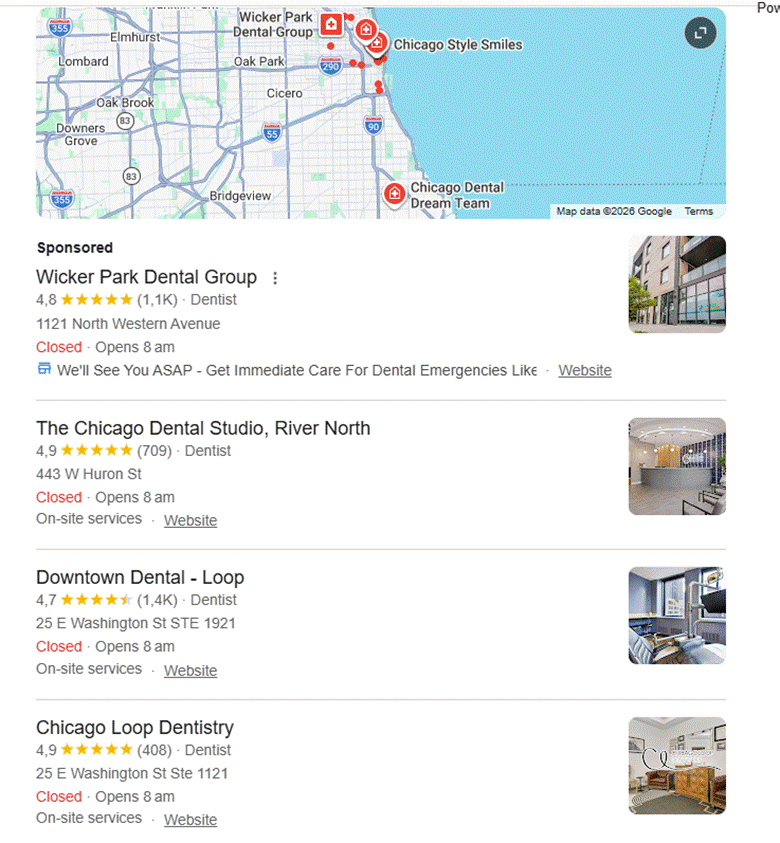
Your Google Business Profile (formerly Google My Business) is arguably the most valuable asset for local SEO. It is the primary factor that determines whether you appear in the “Local Pack”—the map and list of three businesses that appear at the very top of Google’s search results.
Optimization goes beyond simply claiming your listing. You need to complete all available fields. Ensure your business name, address, and phone number (NAP) are accurate and exactly match what appears on your website. Select the correct primary category (Orthodontist) and secondary categories (Dental Clinic, Cosmetic Dentist) if applicable.
Visuals matter immensely here. Upload high-quality photos of your office, your team, and successful before-and-after case studies.
Regular updates are also crucial; use the “Updates” feature to post about special offers, new blog posts, or office news. This activity signals to Google that your practice is active and engaged, which can boost your visibility in search results.
3. Prioritize “NAP” Consistency
As mentioned regarding your Google Business Profile, NAP stands for Name, Address, and Phone number. Search engines view consistency in this data as a trust signal.
If your website lists your address as “123 Main St, Suite A,” but your Facebook page says “123 Main Street #A,” and a local directory says “123 Main,” these slight discrepancies can confuse Google’s algorithms.
When search engines encounter conflicting information, their confidence in your business’s legitimacy drops, which can negatively impact your rankings.
You must audit every place your practice is listed online—from major directories like Yelp and Healthgrades to local chamber of commerce sites.
Ensure the formatting is identical across the board. If you have moved offices or changed phone numbers in the past, there may be “ghost” listings floating around the internet with incorrect data. Cleaning up these citations is a tedious but necessary part of SEO for orthodontists.
4. Develop Practice-Specific Content
Content is the engine that drives SEO, but generic content won’t cut it. Many orthodontic websites rely on canned content provided by web developers—generic pages about “What are braces?” that exist on thousands of other sites. Google filters out duplicate content, meaning these pages provide zero SEO value.
You need unique, authoritative content tailored to your practice. Justin Morgan often emphasizes the “invisible link” between content quality and conversion. Your content should do two things: satisfy search engines and convince human readers.
Start a blog that addresses local events, community involvement, or patient success stories. Create detailed service pages for every treatment you offer. Instead of a single “Treatments” page, create separate, in-depth pages for “Invisalign for Teens,” “Clear Ceramic Braces,” “Surgical Orthodontics,” and “Retainers.” This granular approach allows you to rank for a wider variety of specific search terms.
5. Leverage Patient Reviews
Reviews are the digital version of word-of-mouth referrals. They are a direct ranking factor for local search, but perhaps more importantly, they are the deciding factor for prospective patients.
A practice with 4.8 stars and 200 reviews will almost always win the click over a practice with 5.0 stars and only 2 reviews.
You need a proactive strategy for generating reviews. Don’t leave it to chance. Train your staff to ask happy patients for feedback immediately after they remove their braces—when their excitement is at its peak.
You can also use automated software to send text or email reminders with a direct link to your Google review page.
Responding to reviews is equally important. Reply to every review, positive or negative. This shows prospective patients that you care about patient experience. When handling negative reviews, remain professional and HIPAA-compliant. A thoughtful response to a bad review can sometimes be more impressive to a reader than a generic five-star rating.
6. Focus on Mobile Optimization and Page Speed
We live in a mobile-first world. Google now uses the mobile version of your website for indexing and ranking. If your site looks great on a desktop but is clunky, slow, or hard to navigate on a smartphone, your rankings will suffer.
Orthodontic patients, particularly parents and teenagers, are constantly on their phones. If they land on your site and it takes more than three seconds to load, they will bounce back to the search results and click on your competitor.
This “bounce rate” sends a negative signal to Google that your site provides a poor user experience.
You can check your site’s performance using Google’s free PageSpeed Insights tool. It will provide a score and specific recommendations for improvement, such as compressing images, enabling browser caching, and minimizing code. Ensuring your site is technically sound is a prerequisite for ranking in competitive markets.
7. Build High-Quality Local Backlinks
Backlinks—links from other websites pointing to yours—are like votes of confidence in the eyes of search engines.
However, not all votes are equal. A link from a spammy directory can actually hurt you, while a link from a reputable local source can skyrocket your authority.
For orthodontists, local relevance is key. You don’t need a link from the New York Times; you need links from businesses and organizations in your specific geographic area. This signals to Google that you are a prominent entity in your local community.
Strategies for building local backlinks include:
- Sponsoring local Little League teams or school events (often, they will put your logo and a link on their site).
- Partnering with general dentists for referrals and swapping guest blog posts.
- Getting featured in local news outlets or community blogs.
- Joining the local Chamber of Commerce.
8. Implement Schema Markup
Schema markup is a form of micro-data that you add to your website’s code. It helps search engines understand the context of your content. For an orthodontist, utilizing “LocalBusiness” and “MedicalOrganization” schema is essential.
This code tells Google explicitly: “We are an orthodontist. We are located at these coordinates. We are open at these hours. Here is our aggregate review rating.”
One of the biggest benefits of Schema is the potential for “rich snippets.” These are the enhanced search results that show extra information, like star ratings, FAQs, or event dates, directly on the search results page.
These visual differentiators can significantly increase your Click-Through Rate (CTR), driving more traffic to your site even if your ranking position doesn’t change.
9. Create Video Content
Video is rapidly becoming the preferred medium for consuming content online. YouTube is the second largest search engine in the world, and videos often appear in Google search results for “how-to” and educational queries.
Creating video content humanizes your practice. A short video of the lead orthodontist explaining the difference between Invisalign and braces builds trust before the patient ever walks through the door. Patient testimonials in video format are incredibly persuasive.
From an SEO perspective, embedding videos on your website increases “dwell time”—the amount of time a user spends on your page. Higher dwell times signal to Google that your content is engaging and valuable, which can boost your rankings. Ensure your videos are optimized with relevant titles, descriptions, and tags.
10. Track, Measure, and Adapt
SEO is not a “set it and forget it” strategy. The algorithms change, competitors adjust their tactics, and search behaviors evolve. To succeed, you must make decisions based on data, not guesses.
You need to have Google Analytics 4 (GA4) and Google Search Console set up correctly. These tools allow you to track:
- Where your traffic is coming from (Organic, Direct, Social).
- Which keywords are driving clicks?
- Which pages on your site are the most popular?
- How many users are converting (calling the office or filling out a contact form).
Regularly reviewing this data helps you identify what is working and what isn’t. If a particular blog post is getting a lot of traffic, write more on that topic. If a certain service page has a high bounce rate, redesign it.
Justin Morgan emphasizes that SEO is an iterative process; the businesses that win are those that consistently monitor their performance and adapt.
Frequently Asked Questions
How long does it take for SEO to work for an orthodontist?
SEO is a long-term investment. While some technical fixes can yield quick wins, building authority and climbing rankings typically takes 6 to 12 months. Factors influencing this timeline include the competitiveness of your local market, the current state of your website, and the aggressiveness of your content strategy.
Do I really need a blog for my orthodontic website?
Yes. A blog allows you to target long-tail keywords that simply don’t fit on your main service pages. It establishes your expertise and provides fresh content for search engines to index. It is one of the most effective ways to broaden your reach and capture patients in the research phase of their journey.
Can I do SEO myself, or should I hire an agency?
You can certainly handle the basics—such as claiming your Google Business Profile and requesting reviews—yourself. However, comprehensive SEO involves technical website maintenance, content creation, link building, and analytics. For busy orthodontists, partnering with a specialized agency or consultant often provides a better ROI, allowing you to focus on patient care while experts handle the marketing.
Start Climbing the Rankings Today
Implementing these ten tips will put your practice well ahead of competitors still relying on outdated marketing methods.
SEO for orthodontists is about visibility, trust, and authority. By optimizing your local presence, creating valuable content, and ensuring a seamless technical experience, you can turn your website into your practice’s most powerful growth tool.
The digital landscape is competitive, but it is not insurmountable. Start with an audit of your current standing, identify your gaps, and begin applying these principles.
Whether you tackle them one by one or overhaul your strategy entirely, the effort you put into SEO today will pay dividends in new patient starts for years to come.
Leave a Reply