
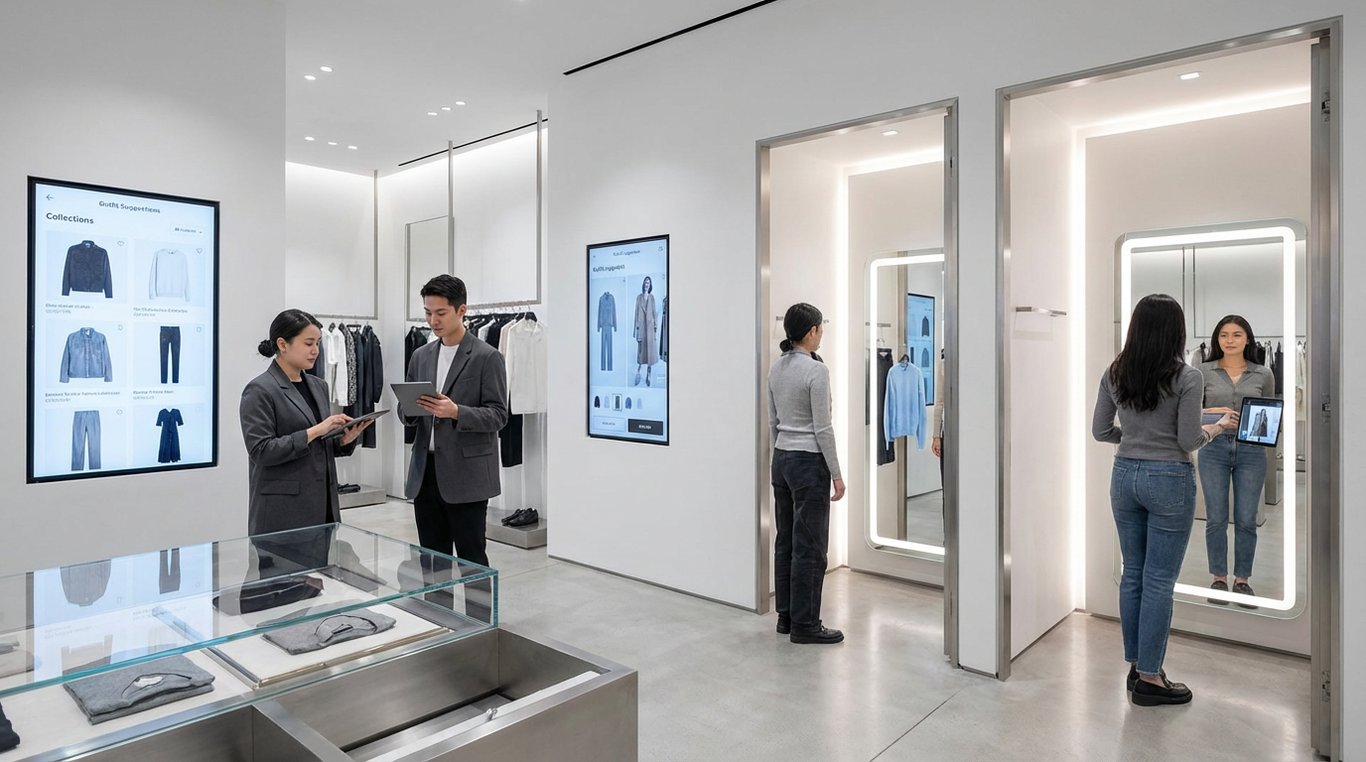
This technological evolution addresses persistent industry challenges while creating competitive advantages through improved operational efficiency, reduced return rates, enhanced customer loyalty, and the ability to respond rapidly to shifting market demands.
What is fashion technology and why does it matter for retail
Imagine a shopper effortlessly trying on clothes from the comfort of their home, or a boutique owner predicting the exact inventory needed for the next season. This is the power of fashion technology.
The integration of technology in fashion retail has revolutionized how consumers interact with clothing, moving beyond simple online transactions to create immersive and personalized shopping experiences. From initial product discovery to post-purchase engagement, technology is reshaping the entire customer journey.
At its core, this technological evolution addresses persistent challenges that have plagued the apparel industry for generations. Sizing inconsistencies, the inability to visualize products in context, inefficient inventory management, and disconnected shopping experiences across channels have all found solutions through innovative applications of emerging technologies. When a customer uses their smartphone to virtually try on sunglasses or receives personalized product recommendations based on their browsing history and body measurements, they’re experiencing the practical benefits of these advancements.
Key Benefits of Fashion Technology
- Enhanced Customer Experience: Virtual try-on capabilities and personalized recommendations create more engaging and confident shopping experiences
- Operational Efficiency: Automated inventory management and predictive analytics optimize resource allocation and reduce waste
- Competitive Advantage: Data-driven decision making enables proactive responses to market trends and customer preferences
- Reduced Returns: Better product visualization and fit prediction decrease return rates and associated costs
- Omnichannel Integration: Seamless experiences across physical stores, websites, and mobile applications capture broader customer engagement
What distinguishes modern retail from traditional approaches is the integration of data-driven decision making at every level. Rather than relying solely on intuition or historical patterns, today’s successful retailers leverage real-time information about customer preferences, inventory levels, supply chain dynamics, and market trends. This shift from reactive to proactive operations enables businesses to anticipate needs, personalize interactions, and optimize resources in ways that create measurable value for both the company and its customers.
As technology continues to redefine the fashion retail landscape, understanding the key trends driving its adoption is crucial for staying competitive. The next section explores these trends, highlighting the evolving consumer expectations and market dynamics that are shaping the future of fashion retail.
Fashion industry trends driving technological adoption
What consumer behaviors are pushing fashion retailers toward technology investment?
Consumer expectations have evolved dramatically, creating pressure on retailers to invest in technological capabilities or risk losing market share to more digitally sophisticated competitors. Today’s shoppers expect personalized recommendations, flexible fulfillment options, transparent supply chains, and frictionless experiences regardless of how they choose to engage with a brand. These expectations, shaped by experiences with technology leaders across industries, have made digital transformation essential rather than optional for fashion retailers.
Market Forces Accelerating Digital Transformation
- E-commerce Acceleration: Global disruptions to physical retail fundamentally altered shopping behaviors and increased online spending
- Lowered Entry Barriers: Direct-to-consumer brands and marketplace platforms enable new competitors to reach global audiences
- Omnichannel Expectations: Customers demand seamless experiences across all touchpoints and channels
- Speed Requirements: Faster fulfillment, instant customer service, and real-time inventory visibility have become baseline expectations
The acceleration of e-commerce has fundamentally altered market dynamics. Consumers who previously preferred in-store shopping discovered the convenience of online purchasing, while those already comfortable with digital channels increased their spending. This shift created urgency for retailers to enhance their digital capabilities, improve website functionality, and develop robust fulfillment infrastructure. Brands that had invested in omnichannel strategies before these disruptions found themselves better positioned to capture demand, while those relying primarily on physical stores faced existential challenges.
Competitive pressures have intensified as barriers to entry in fashion retail have lowered. Direct-to-consumer brands leverage technology to reach customers without traditional wholesale relationships, while marketplace platforms enable small businesses to access global audiences. Established retailers must differentiate themselves through superior experiences, operational efficiency, or unique value propositions—all of which increasingly depend on technological capabilities. The companies that successfully integrate innovation into their operations gain advantages in speed, personalization, and customer engagement that prove difficult for competitors to replicate.
With these fashion industry trends in mind, one technology stands out for its transformative potential: artificial intelligence. The following section will delve into how AI in fashion retail is revolutionizing fashion retail through personalization and predictive analytics, offering unprecedented opportunities for businesses to enhance customer experiences and optimize operations.
AI in fashion retail – personalization and predictive analytics
How AI Creates Personalized Shopping Experiences
Artificial intelligence has become the foundation for creating individualized shopping experiences at scale. By analyzing vast amounts of customer data—including browsing behavior, purchase history, demographic information, and engagement patterns—AI systems identify preferences and predict future needs with remarkable accuracy. When a customer visits a retailer’s website, algorithms instantly process this information to display products most likely to resonate with that specific individual, dramatically increasing the probability of conversion compared to generic product displays.
Key AI Applications in Fashion Retail
- Virtual Shopping Assistants: AI-powered chatbots provide 24/7 personalized guidance throughout the customer journey
- Predictive Analytics: Machine learning algorithms forecast demand with increasing accuracy to optimize inventory levels
- Dynamic Pricing: Real-time price adjustments based on demand, competition, and market conditions
- Marketing Automation: Personalized campaigns tailored to individual customer segments and behaviors
- Recommendation Engines: Product suggestions based on browsing patterns, purchase history, and similar customer profiles
Virtual shopping assistants powered by AI provide personalized guidance throughout the customer journey. These systems answer questions about product features, sizing, availability, and styling, offering support that mimics the assistance of knowledgeable sales associates. Unlike human staff, these digital assistants operate continuously, handle unlimited simultaneous conversations, and maintain consistent knowledge across the entire product catalog. For boutique owners with limited staff, this technology extends customer service capabilities without proportional increases in labor costs.
Predictive analytics transforms inventory management from reactive guesswork to data-driven precision. Machine learning algorithms analyze historical sales data, seasonal patterns, weather forecasts, social media trends, and economic indicators to forecast demand with increasing accuracy. This capability enables retailers to align inventory levels with anticipated needs, reducing both stockouts that result in lost sales and excess inventory that requires markdowns. A boutique implementing predictive analytics might discover that certain styles consistently sell better during specific weather conditions, allowing proactive stocking decisions that maximize profitability.
Dynamic pricing represents another powerful application of AI in retail operations. Algorithms continuously monitor competitor pricing, inventory levels, demand signals, and market conditions to adjust prices in real-time. This approach maximizes revenue by capturing willingness to pay while remaining competitive. During periods of high demand or low inventory, prices increase to optimize margins, while slower periods or excess stock trigger strategic markdowns to accelerate sales. The sophistication of these systems far exceeds manual pricing strategies, processing variables and making adjustments at speeds impossible for human teams.
AI-driven marketing automation has revolutionized how retailers communicate with customers. Systems generate personalized email campaigns, social media content, and advertising materials tailored to individual customer segments. By analyzing which messages, images, and offers resonate with different audiences, these platforms continuously optimize marketing effectiveness. A small business owner can achieve marketing sophistication previously available only to large enterprises with dedicated creative teams, leveling the competitive playing field.
Beyond AI, augmented reality is transforming the way customers interact with products, particularly through virtual try on technology. The next section explores how AR experiences are enhancing the shopping journey and driving tangible business benefits for fashion retailers.
Virtual try on technology and augmented reality experiences
How Virtual Try-On Technology Works
Augmented reality has addressed one of online shopping’s most persistent challenges: the inability to physically interact with products before purchase. Virtual try on technology applications use smartphone cameras and sophisticated image processing to overlay digital representations of clothing, accessories, or cosmetics onto live video of the customer. This technology allows shoppers to visualize how products will look on their specific body type, skin tone, or in their personal environment, dramatically reducing uncertainty that often prevents online purchases.
Benefits of AR Technology for Retailers and Consumers
- Reduced Return Rates: Better product visualization leads to more confident purchase decisions and fewer returns
- Increased Conversion: Smart mirrors in fitting rooms boost in-store conversion rates through enhanced experiences
- Enhanced Confidence: Customers can assess fit, style, and appearance before purchasing
- Expanded Inventory Display: Showcase full product ranges without physical space limitations
- Social Integration: Enable sharing for feedback from friends and social networks
In physical retail environments, smart mirrors retail create interactive fitting room experiences that blend digital convenience with in-store shopping. These displays recognize items customers bring into fitting rooms, suggest complementary products, allow requests for different sizes or colors without leaving the space, and even enable social sharing for feedback from friends. By enhancing the traditional fitting room experience with digital capabilities, retailers increase conversion rates while gathering valuable data about customer preferences and product performance.
The impact on return rates represents one of the most compelling business cases for virtual try on technology. Returns cost retailers significantly through shipping expenses, processing labor, and lost selling opportunities when items remain out of stock during the return cycle. When customers can accurately assess fit, style, and appearance before purchasing, they make more confident decisions that result in fewer returns. Brands implementing these solutions have documented return rate reductions of up to six percent, directly improving profitability while enhancing customer satisfaction.
Beyond apparel, augmented reality enables customers to visualize products in their intended context. Furniture retailers allow shoppers to see how pieces will look in their homes, while eyewear brands let customers try on hundreds of frame styles instantly. This contextual visualization removes guesswork and builds purchase confidence, particularly for higher-priced items where uncertainty might otherwise prevent transactions. The technology proves especially valuable for boutique owners whose limited physical inventory cannot showcase the full range of available options.
As the lines between online and offline shopping continue to blur, retailers are increasingly adopting omnichannel strategies to provide seamless experiences across all touchpoints. The next section explores how omnichannel retail technology and unified commerce platforms are transforming the shopping journey.
Omnichannel retail technology and unified commerce platforms
How do modern retailers create seamless experiences across online and physical channels?
The distinction between online and offline shopping has blurred as consumers expect seamless experiences regardless of how they choose to engage with brands. Successful omnichannel strategies recognize that customers might research products on social media, check inventory on a mobile app, visit a physical store to examine items, and complete purchases on a website—all as part of a single shopping journey. Technology platforms that unify these touchpoints create cohesive experiences that meet modern expectations while providing retailers with comprehensive customer insights.
Essential Omnichannel Technology Components
- Unified Inventory Management: Real-time stock visibility across warehouses, distribution centers, and individual store locations
- Customer Data Integration: Complete profiles including purchase history, preferences, and interactions across all channels
- Flexible Fulfillment Options: Buy-online-pickup-in-store, ship-from-store, and reserve-online-try-in-store capabilities
- Cross-Channel Loyalty Programs: Integrated rewards systems that work seamlessly across online and offline touchpoints
- Consistent Communication: Coordinated messaging and branding across all customer interaction points
Real-time inventory visibility across all channels represents a foundational requirement for effective omnichannel operations. When a customer checks product availability online, the system must reflect actual stock levels in warehouses, distribution centers, and individual store locations. This accuracy enables features like buy-online-pickup-in-store, ship-from-store, and reserve-online-try-in-store that provide flexibility customers increasingly demand. Without unified inventory systems, retailers risk disappointing customers with inaccurate information or missed sales opportunities when products exist but cannot be located or allocated efficiently.
Customer data integration proves equally critical for delivering personalized experiences across touchpoints. A unified commerce platform maintains complete customer profiles that include purchase history, browsing behavior, preferences, and interactions across all channels. When a customer who frequently shops online visits a physical store, sales associates can access this information to provide informed recommendations and personalized service. Similarly, online experiences can reflect in-store purchases and preferences, creating continuity that strengthens customer relationships and increases lifetime value.
Flexible fulfillment options have become competitive necessities rather than premium features. Customers expect to choose how and where they receive purchases, whether through home delivery, store pickup, curbside collection, or locker retrieval. The technology infrastructure supporting these options must coordinate inventory allocation, order routing, and communication across systems to ensure reliable execution. Retailers offering comprehensive fulfillment flexibility capture sales from customers who might otherwise shop with competitors providing more convenient options.
Loyalty programs gain significantly enhanced effectiveness when unified across channels. Rather than maintaining separate programs for online and in-store purchases, integrated systems reward customers for all engagement with the brand. Points earned online can be redeemed in stores, while in-store purchases contribute to online account benefits. This integration encourages customers to engage through multiple channels, increasing overall spending while providing retailers with more complete data about customer behavior and preferences.
While omnichannel strategies focus on enhancing the customer experience, automation and robotics are transforming the behind-the-scenes operations of fashion retail. The next section explores how these technologies are improving efficiency, accuracy, and cost-effectiveness in warehouses and manufacturing facilities.
Automation and robotics in fashion retail operations
Operational Processes Being Automated in Fashion Retail
Behind-the-scenes automation has transformed fashion retail operations, enabling faster fulfillment, improved accuracy, and reduced labor costs. Warehouse robotics handle inventory movement, order picking, and packing with speed and precision that exceed human capabilities. Autonomous mobile robots navigate warehouse floors, retrieving items and delivering them to packing stations, while robotic arms sort products and prepare shipments. These systems operate continuously without fatigue, dramatically increasing throughput while reducing errors that result in incorrect shipments and customer dissatisfaction.
Key Areas of Retail Automation
- Warehouse Operations: Robotic systems handling inventory movement, order picking, and shipment preparation
- Inventory Management: RFID tags and sensors providing real-time stock tracking and automated replenishment
- Manufacturing: Automated cutting, sewing, and finishing operations with consistent quality
- Quality Control: Computer vision systems inspecting garments for defects faster than human inspectors
- Customer Service: Chatbots and AI assistants handling routine inquiries and support requests
Automated inventory management systems use sensors, RFID tags, and computer vision to track product movement and stock levels in real-time. Rather than relying on periodic manual counts that provide outdated information, these technologies maintain continuous accuracy. When inventory falls below predetermined thresholds, systems automatically generate replenishment orders, ensuring products remain available without manual intervention. This automation frees staff to focus on customer-facing activities while reducing stockouts and excess inventory.
Manufacturing automation has advanced significantly, with robotic systems handling cutting, sewing, and finishing operations that traditionally required skilled human labor. Automated fabric cutters use computer-controlled lasers or blades to cut patterns with minimal waste, while robotic sewing systems assemble garments with consistent quality. These technologies enable on-demand production models where items are manufactured only after orders are received, eliminating the need for large inventory investments and reducing waste from unsold merchandise.
Quality control automation employs computer vision systems to inspect garments for defects, inconsistencies, or damage. Cameras capture detailed images that algorithms analyze, identifying issues like stitching irregularities, color variations, or fabric flaws faster and more consistently than human inspectors. This technology reduces the likelihood of defective products reaching customers while lowering the labor costs associated with manual inspection processes.
As we look ahead, several key trends are poised to shape the future of retail technology. The next section explores these trends, highlighting the emerging technologies that are gaining traction and transforming the shopping experience.
Current retail technology trends shaping the future
What emerging technologies are gaining momentum in fashion retail today?
The retail landscape continues evolving rapidly as emerging technologies gain traction and consumer behaviors shift. Social commerce has transformed how customers discover and purchase products, with platforms like Instagram, TikTok, and Pinterest integrating shopping functionality directly into social experiences. Rather than viewing products on social media and then navigating to separate websites to complete purchases, customers can now buy directly within the apps where they spend significant time. This seamless integration reduces friction in the purchase process while allowing brands to capitalize on impulse buying driven by influencer content and peer recommendations.
Key Retail Technology Trends for 2026
- Social Commerce Integration: Direct purchasing capabilities within social media platforms reducing friction in the buying process
- Live Shopping Experiences: Real-time video broadcasts combining entertainment with commerce through product demonstrations
- Virtual Stores and Metaverse: Immersive three-dimensional shopping environments using avatars and virtual reality
- AI Shopping Agents: Autonomous assistants providing proactive shopping recommendations and personalized guidance
- Advanced Personalization: Individual product variations and pricing tailored to specific customer preferences
Live shopping experiences, popularized in Asian markets and gaining momentum globally, combine entertainment with commerce through real-time video broadcasts featuring product demonstrations, limited-time offers, and interactive engagement. Hosts showcase products, answer viewer questions, and create urgency through flash sales and exclusive deals available only during the broadcast. This format proves particularly effective for fashion products where seeing items in motion, understanding styling options, and hearing detailed descriptions enhances purchase confidence. Retailers experimenting with live shopping report engagement levels and conversion rates that significantly exceed traditional e-commerce channels.
Virtual stores and metaverse experiences represent the frontier of digital retail, creating immersive environments where customers can browse, interact, and purchase using avatars in three-dimensional spaces. While still emerging, these platforms offer possibilities for brand expression and customer engagement that transcend physical and traditional digital limitations. Fashion brands have been early experimenters, creating virtual boutiques, hosting digital fashion shows, and even selling digital-only clothing for avatars. As virtual and augmented reality technologies improve and adoption increases, these experiences may become significant channels for customer engagement and revenue generation.
Personalization technologies continue advancing, with AI systems now capable of generating individualized product recommendations, customized marketing messages, and even unique product variations tailored to individual customer preferences. Rather than offering the same products to all customers, retailers can create personalized assortments, pricing, and promotions based on detailed understanding of each customer’s preferences, behaviors, and value to the business. This level of individualization was impossible at scale before modern AI capabilities, but now represents a competitive advantage for retailers with the data infrastructure and analytical capabilities to implement these approaches.
With seventy percent of Gen Z consumers expressing interest in AI shopping agents according to industry research, autonomous AI agents are reshaping how consumers discover, shop, and engage. From proactive shopping companions to embedded styling assistants, these technologies are changing the speed, scale, and structure of customer interaction. Organizations should assess where these capabilities fit in their models—how they can extend service, elevate loyalty, and drive conversion—before competitors shape customer expectations.
While the potential benefits of these technologies are significant, implementing them successfully requires careful planning and execution. The next section explores the challenges and best practices for implementing fashion retail technology, providing guidance for retailers looking to navigate this complex landscape.
Implementing fashion retail technology – challenges and best practices
What obstacles do retailers face when adopting new technologies?
Successfully integrating new technologies into retail operations requires more than simply purchasing software or hardware—it demands strategic planning, organizational alignment, and sustained commitment. Financial considerations present immediate challenges, with technology investments in the fashion industry projected to increase from approximately 1.7 percent of revenue in 2021 to between 3 and 3.5 percent by 2030 according to industry research. This escalating investment reflects both the importance of technological advancement and the substantial resources required for meaningful transformation.
Common Implementation Challenges
- Budget Constraints: Balancing competing priorities while ensuring sufficient resources for successful deployment
- Data Infrastructure: Establishing clean, connected data systems across all business functions
- Technical Integration: Coordinating multiple systems to deliver seamless omnichannel experiences
- Organizational Change: Managing employee training and cultural shifts required for technology adoption
- Privacy and Compliance: Ensuring data security and regulatory compliance across all technology implementations
Budget allocation decisions must balance competing priorities while ensuring sufficient resources for successful implementation. Robotics, AI platforms, and enterprise software systems require significant upfront capital expenditure plus ongoing costs for licensing, maintenance, upgrades, and training. Poorly planned deployments result in overlapping tools, disconnected systems, and accumulated technical debt that proves costly to maintain and difficult to optimize. Developing clear evaluation frameworks based on return on investment, strategic alignment, and scalability helps organizations make informed decisions about where to allocate limited resources.
Technology Implementation Best Practices
- Start with Data Foundation: Establish unified data layers and clean information systems before pursuing advanced analytics
- Conduct Pilot Programs: Test technologies in controlled environments with defined goals and metrics
- Ensure Strategic Alignment: Connect every technology decision to brand identity, customer expectations, and business objectives
- Plan for Integration: Design systems that communicate seamlessly across channels and touchpoints
- Invest in Change Management: Provide comprehensive training and support for employees adapting to new technologies
- Choose the Right Partners: Work with vendors who understand fashion retail specifics and provide ongoing support
Data infrastructure represents a critical foundation that many organizations underestimate. While businesses pursue AIstrategies and advanced analytics, competitive advantage begins with clean, connected data across systems, channels, and customer touchpoints. Information must be actionable, accessible, and integrated across marketing, merchandising, customer service, supply chain, and other functions to enable the personalization and operational agility that modern retail demands. Organizations should begin by mapping where data currently resides, establishing unified data layers, and investing in systems that capture real-time, reliable information ready for activation across the business.
Privacy and ethical considerations accompany technology adoption, particularly for systems that collect and analyze customer information. Smart textiles, virtual try on technology applications, and AI-powered personalization all rely on data that customers may consider sensitive. Brands require explicit consent practices, transparent data usage policies, and secure retention systems to avoid compliance violations and privacy breaches that damage customer trust and potentially result in regulatory penalties. Sustainability claims must withstand scrutiny with demonstrated proof, while automation implementations should consider workforce impacts and ensure fair treatment of employees whose roles may change.
Technical integration complexity often exceeds initial expectations, particularly for omnichannel strategies that require high levels of coordination between previously separate systems. Inventory platforms, customer databases, point-of-sale systems, e-commerce platforms, and marketing tools must communicate seamlessly to deliver the consistent experiences customers expect. A customer researching products online, checking store availability, and purchasing through a mobile app for in-store pickup relies on multiple systems working in concert. Achieving this integration requires significant investment in middleware, APIs, and system architecture while ensuring staff receive training to manage processes that span multiple channels.
Organizational change management frequently determines whether technology investments deliver expected value. Even the most sophisticated systems fail if employees resist adoption or lack the skills to use them effectively. Successful implementations involve comprehensive training programs, clear communication about how changes benefit both the organization and individual employees, and cultural shifts that embrace innovation rather than viewing it as threatening. Cross-functional teams with shared access to data and unified customer views break down traditional silos that impede seamless experiences.
Strategic alignment ensures technology investments support business objectives rather than pursuing innovation for its own sake. Every technology decision should connect to brand identity, customer expectations, and business models. Organizations benefit from developing evaluation frameworks that assess potential investments against clear criteria including return on investment, brand relevance, and scalability. Conducting intentional pilots with defined goals and metrics allows teams to validate assumptions and demonstrate value before committing to full-scale deployments, while maintaining willingness to discontinue initiatives that fail to deliver measurable results.
Designing for actual customer behavior rather than idealized channel structures represents an essential best practice. Tomorrow’s customers move fluidly between creator content, social platforms, physical stores, and digital touchpoints without thinking in discrete steps or channels. Engagement ecosystems should reflect how people actually discover, evaluate, and purchase rather than forcing them into predetermined pathways. Success requires building adaptive architectures that integrate AI agents, physical and digital touchpoints, and embedded commerce into unified experiences that follow customer behavior rather than organizational structure.
Phased implementation approaches reduce risk while enabling iterative learning. Rather than attempting comprehensive system overhauls, successful organizations often begin with pilot programs in specific departments, product categories, or customer segments. This allows teams to identify challenges, refine processes, and demonstrate value before scaling initiatives across the enterprise. The New York Fashion Tech Lab’s twelve-week program model exemplifies this approach, facilitating controlled testing environments where retail partners evaluate innovations before full deployment.
Vendor selection and partnership quality significantly impact outcomes. Organizations benefit from working with technology providers who understand fashion retail specifics rather than offering generic solutions. Partners should provide not only robust technology but also implementation support, training resources, and ongoing optimization assistance. The most successful implementations involve collaborative relationships where technology providers actively participate in problem-solving and adaptation as challenges emerge, rather than simply delivering software and moving to the next customer.
Navigating the Future of Fashion Retail
The integration of technology in fashion retail is no longer a luxury but a necessity for survival and growth. From AI-powered personalization to augmented reality experiences and sustainable practices, technology is reshaping every aspect of the industry. By embracing these innovations and strategically implementing them, fashion boutique operators and small business owners can enhance customer experiences, optimize operations, and gain a competitive edge in an ever-evolving market.
As you consider the next steps for your business, focus on identifying the technologies that align with your brand identity, customer expectations, and business objectives. Start with pilot programs, measure results, and continuously optimize your approach based on data and feedback. The journey of technological transformation is ongoing, but with careful planning and a commitment to innovation, you can position your business for success in the future of fashion retail.
Leave a Reply