
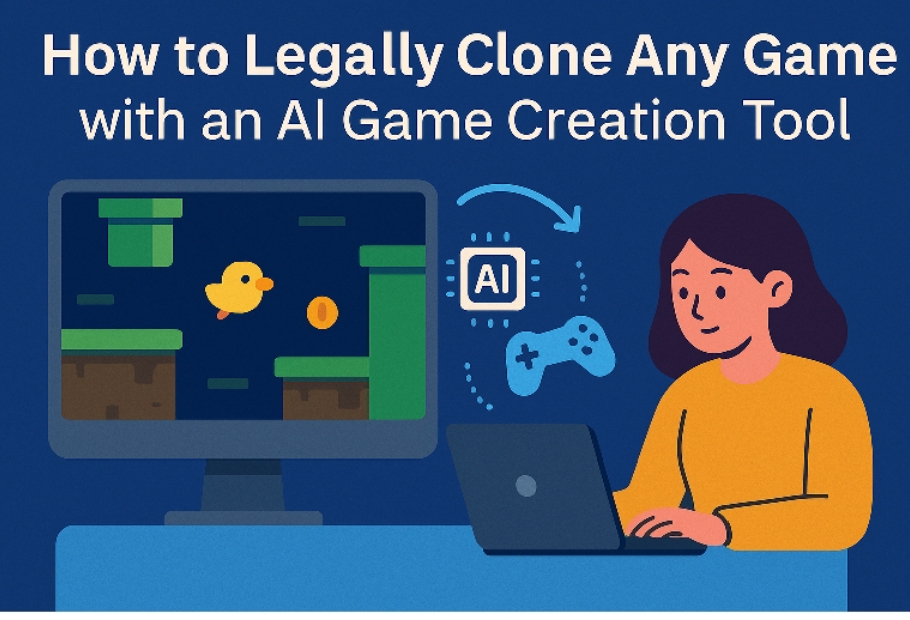
Have you ever played a game like Flappy Bird or Vampire Survivors and thought, “I could make something like this”? Many aspiring game developers start with an idea inspired by a favorite game. It’s a common starting point, but it often leads to a major question: can you legally create a game that’s similar to another one?
The answer is yes, but you have to do it the right way. You can legally clone a game by focusing on its mechanics rather than its creative assets. This means you can borrow the core gameplay idea without infringing on copyright. In this guide, we’ll explain how to do this legally and how modern AI game creation tools make it easier than ever to build your own unique game.
What Does It Mean to “Clone” a Game?
The word “clone” can be misleading. In game development, there’s a big difference between a game that is inspired by another and a direct copy. A true clone is an exact replica, which is illegal. A game that takes inspiration, however, uses similar mechanics but introduces its own original creative elements.
To understand how to clone a game legally, you need to know what is and isn’t protected by copyright law.
What Is Protected by Copyright?
Copyright law protects the specific, creative expression of an idea, not the idea itself. In gaming, this includes:
- Art and Visuals: Character designs, logos, environmental art, and user interface elements are protected. You can’t use another game’s artwork.
- Music and Sound Effects: The original soundtrack and sound design are copyrighted. You cannot copy the audio from another game.
- Code: The source code that runs a game is a creative work and is protected. Copying code is a direct infringement.
- Story and Characters: The plot, dialogue, and specific characters (including their names and backstories) are copyrighted.
Think of it like this: anyone can write a story about a boy wizard who goes to a magic school, but they can’t call him Harry Potter or place him in Hogwarts. The concept is fair game, but the specific creative details are not.
What Is Not Protected by Copyright?
The building blocks of a game are generally not protected by copyright. This is where you have the freedom to create. These elements include:
- Game Mechanics: The rules and systems that define how the game is played. For example, the mechanic of jumping on platforms or matching three colored gems in a row is not ownable.
- Concepts and Ideas: A game’s core concept, like a farming simulator or a battle royale, is not protected. Stardew Valley was heavily inspired by Harvest Moon, but it’s a legal and beloved game because it used its own art, music, and story.
The key is to use a popular game as a starting point for its mechanics, then build something new and original around them.
How to Legally Clone a Game in 4 Steps
Now that you understand the legal distinction between game mechanics vs assets, you can follow a clear process to create your own game. Here’s a step-by-step guide on how to approach it.
Step 1: Deconstruct Your Favorite Game
Before you can build, you need to understand the blueprint. Play the game you want to take inspiration from and break it down into its core game mechanics. Ask yourself what you are actually doing in the game.
Write down every action, rule, and system. Ignore the story, art, and music for now. Just focus on the gameplay loop.
For example, let’s deconstruct the classic game Pac-Man:
- Mechanic 1: Navigate a character through a maze.
- Mechanic 2: Collect all the small items (dots) in the maze.
- Mechanic 3: Avoid enemies (ghosts) that move around the maze.
- Mechanic 4: Temporarily gain the ability to defeat enemies by collecting a special item (power pellet).
These four mechanics are the essence of Pac-Man. They are simple, fun, and not protected by copyright.
Step 2: Brainstorm Your Unique Twist
This is where your creativity comes in. Once you have the core mechanics, it’s time to brainstorm how to make them your own. You can change the theme, add a new mechanic, or create a unique story.
Using our Pac-Man example, here are a few ways to give it a unique twist:
- Change the Theme: Instead of a yellow circle eating dots, maybe your game is about a spaceship collecting stardust in a nebula while avoiding asteroids. The mechanics are the same, but the theme is completely different.
- Add a New Mechanic: What if your character could drop a temporary wall to block enemies? Or what if some collectibles gave you a speed boost? Adding a single new mechanic can dramatically change the feel of the game.
- Create a Unique Story: Your maze-navigation game could be about a mouse stealing cheese from a kitchen before the cat wakes up. This simple narrative provides context and makes the game more engaging.
Your goal is to create a new experience that feels familiar but fresh.
Real example: A creator took Vampire Survivors’ auto-battler loop, swapped the gothic theme for a parking lot game, and added ragdoll physics + multiplayer chaos. Park Master instantly recognizable gameplay, but a completely fresh (and hilarious) experience.
Step 3: Use an AI Game Creation Tool to Build Your Assets
Creating original art, music, and characters is often the biggest hurdle for solo developers. This is where AI game creation tools become incredibly powerful. Instead of spending months learning to draw or compose, you can use AI to generate unique assets based on your new theme.
You can use text prompts to describe what you want. For example, for your space-themed Pac-Man game, you might use prompts like:
- “Pixel art sprite of a small, friendly spaceship with blue rocket trails.”
- “Top-down view of a colorful nebula maze with glowing stardust.”
- “Chiptune-style ambient space music, mysterious and upbeat.”
Want a top-down tank arena game with neon visuals and dubstep beats? Just describe it to Astrocade. One creator did exactly that and built Tankor Arena, a fast-paced multiplayer shooter that feels familiar yet completely original.
This AI tool can help you generate characters, environments, items, and even sound effects that are 100% original and legally yours to use. Ensures you aren’t using any copyrighted material while speeding up development time significantly.
Step 4: Assemble Your Game
With your mechanics defined and your assets generated, it’s time to put everything together. You can use a traditional game engine or an to assemble your game.
If you use an AI-powered platform, the process can be even simpler. Many of these tools are designed for people without coding experience. You can often define the game rules and mechanics using visual editors or simple language. Since you’re building the game from the ground up with your own assets and logic, the final product and its code will be entirely original.
Build Your Dream Game the Right Way
Creating a game inspired by a classic doesn’t have to involve legal risks. The secret to how to clone a game legally is to borrow the core mechanics and build a new, creative experience around them. By focusing on creating your own unique art, story, and sound, you can pay homage to your favorite games while still producing something that is entirely yours using Astrocade AI.
With the rise of AI game creation tools, this process is more accessible than ever. You no longer need a large team or extensive technical skills to bring your vision to life. The tools are there to help you create original assets and assemble your game quickly.
Leave a Reply