AI agent collaboration is easy to start and difficult to sustain. This article covers the coordination models behind multi-agent work, the components that make it reliable, the platforms worth evaluating, and the governance boundaries that keep people accountable.
What is AI agent collaboration?
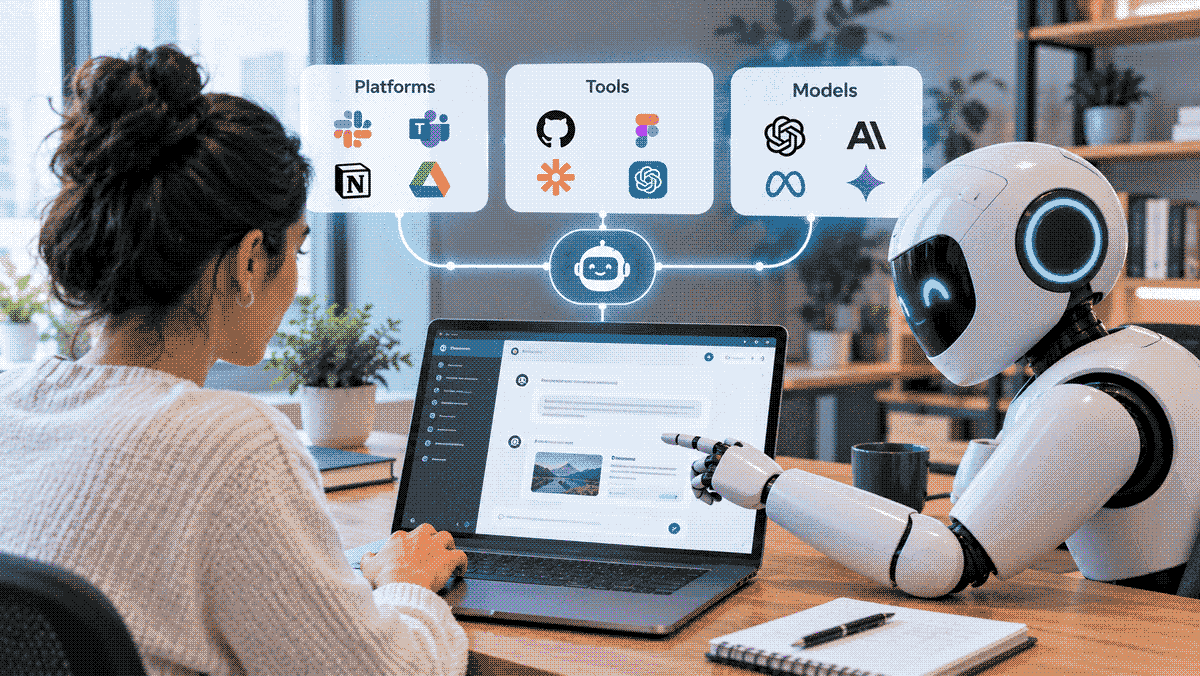
AI agent collaboration is the arrangement under which several autonomous agents, and the people responsible for them, work on the same objective with shared state rather than isolated chat threads. Each agent holds a role, a scope, and a set of tools. The collaboration is the part that connects them: the plan, the owner, the status, the blockers, the dependencies, and the open decisions.
The idea is old. Multi-agent systems have been a distinct subfield of distributed AI since the 1980s, with established research on coordination, negotiation, and task allocation. What changed is that the agents are now language-model-driven, which makes them easy to instantiate and unreliable in ways classical agents were not.
A common failure is treating the chat window as the system of record. Chat carries messages well, but it holds no structure. When four agents report progress in four threads, the shared plan exists only in the operator’s head.
Why do AI agents need to collaborate?
Agent count grows because scope grows. A single agent handling research, implementation, review, and reporting tends to degrade on context length, tool breadth, and error recovery. Splitting the work into specialized agents reduces blast radius per failure, but it introduces handoffs, and every handoff is a place where state can be lost.
Collaboration is how that cost is paid down. The work is decomposed into owned units, and the state of each unit stays visible to every participant that depends on it.
The tradeoff is real: multi-agent designs add orchestration overhead, token cost, and new failure modes. Published multi-agent evaluations attribute a large share of task failures to coordination errors such as unclear role boundaries, lost context at handoffs, and premature termination, rather than to model capability. Splitting work should be a deliberate decision.
Benefits of AI agent collaboration for teams and workflows
- Parallel throughput: Independent units of work proceed at once instead of queueing behind a single runtime.
- Role specialization: A review agent with a narrow tool set and a narrow prompt tends to produce more consistent findings than a generalist handling the same work alongside everything else.
- Contained failure: When one agent stalls or produces an unusable artifact, recovery is scoped to that unit rather than the whole run.
- Legible ownership: Each task carries an owner, a status, and a dependency list, so a person can tell what is waiting and on whom.
- Durable handoffs: Output passes as a recorded artifact that a human never has to relay.
When a single AI agent is not enough
A single agent is sufficient when the task is short, the tools are few, and one person can read the entire transcript. Past that point, the transcript stops being readable. The agent begins to summarize its own earlier reasoning, and the operator loses the ability to verify what was actually done.
The practical threshold is the handoff. Once output from one step becomes input to a step with a different owner, scope, or tool set, you are running a multi-agent system whether you designed one or not.
Key components and models of multi-agent collaboration
Agentic AI multi-agent collaboration rests on three layers: what each agent is allowed to do, how agents exchange information, and who decides what happens next. The components are consistent across frameworks even when the terminology differs.
Agent roles, autonomy, and task specialization
A role is a scope statement with teeth. It names the agent’s objective, the tools in its registry, the data it may read, and the actions it may take without approval. Autonomy is set per role, not globally.
Specialization reduces ambiguity at the boundary. A planner that only produces task breakdowns, a builder that only writes and runs code, and a reviewer that only returns findings create clean handoff points. The agents can work in parallel, but the developer’s attention cannot, so the boundaries need to be readable at a glance.
Communication, shared memory, and coordination protocols
Communication is the part teams usually under-build. Direct agent-to-agent messaging moves instructions and results, while shared memory holds the state both agents need to agree on: the current plan, the accepted artifacts, and the decisions already made.
Without shared memory, two agents can hold different versions of the same plan and both be internally consistent. The developer then has to work out which version is current. Two open specifications address parts of this exchange. Anthropic’s Model Context Protocol (MCP), released in November 2024, standardizes how agents connect to tools and context sources. The Agent2Agent protocol (A2A), introduced by Google in April 2025 and contributed to the Linux Foundation shortly after, standardizes inter-agent messaging and capability discovery. Both are young, and adoption varies by framework.
Centralized, decentralized, and hierarchical multi-agent models
- Centralized orchestration: A single orchestrator assigns tasks, collects results, and holds the plan. Predictable and auditable, but the orchestrator is a bottleneck and a single point of failure.
- Decentralized mesh: Agents discover each other through a registry and negotiate work directly. Resilient and scalable, though harder to audit without a shared state layer.
- Hierarchical delegation: Supervisor agents own sub-teams and report upward. This mirrors how human organizations scale, and it localizes recovery to the level where the failure occurred, at the cost of added latency per layer.
Most production systems are hybrids rather than pure forms.
How multi-agent AI collaboration works: a visual diagram
A multi-agent AI collaboration diagram is useful because it separates two things that chat transcripts blend together: the path a task takes and the state that path leaves behind.
Read the diagram as two overlapping planes. One plane carries messages, delegation, and tool calls between participants. The other keeps the plan, the owners, the statuses, and the decisions visible to everyone, including the human who steps away and returns an hour later.
Multi-agent AI collaboration diagram: task routing, feedback, and output
- Intake and decomposition: A request enters the system and a planner breaks it into discrete tasks with owners, dependencies, and acceptance conditions.
- Routing and delegation: Each task is routed to the agent whose role and registered tools match it. The assignment is recorded rather than implied.
- Execution and tool calls: The assigned agent works within its scope, invoking tools through a governed adapter layer, with every call logged for audit.
- Feedback and review: A reviewer agent or a human returns findings against the acceptance conditions. Findings attach to the task, not to a chat thread.
- State update: Status, blockers, and open decisions update in the shared workspace so dependent tasks can proceed or wait correctly.
- Output and handoff: The accepted artifact passes to the next owner as a referenced object, and the task closes with its history intact.
That sequence is an idealized reference flow; real systems loop, retry, and escalate out of order. Each platform implements it differently.
Top multi-agent collaboration tools and platforms
Platform selection follows the flow above. Some products give you the framework to build routing and delegation yourself. Others provide the runtime, registry, and governance around agents you have already built. The top multi-agent collaboration tools in AI divide along roughly that line, and conflating the two categories is a common evaluation mistake.
Frameworks for building and orchestrating AI agent teams
The list below is a representative sample, not a ranking, and capabilities change release to release.
- Band: A collaboration layer where agents and people share one workspace. Band keeps the work visible through plans, owners, status, blockers, and dependencies, while its delegation layer carries messages and handoffs between participants. Aimed at teams running mixed human and agent workstreams that need an audit trail.
- CrewAI: An open-source, role-based Python framework for defining agent crews with assigned tasks and sequential or hierarchical processes. Fast to prototype with, code-first by design.
- LangGraph: Graph-based orchestration from the LangChain team, built around explicit state, nodes, and edges. Strong for deterministic control flow, cycles, and checkpointed recovery in long-running runs.
- Microsoft AutoGen: A conversational multi-agent framework originating in Microsoft Research, centered on agents exchanging messages to solve a task, with support for human-in-the-loop steps and code execution.
- Google Vertex AI Agent Builder: Managed infrastructure for building and deploying agents on Google Cloud, with native model access, enterprise identity, and deployment tooling. Deepest value if you are already on GCP.
- Relevance AI: A low-code environment for assembling agent teams around business workflows, aimed at operations users rather than platform engineers.
- Lindy: A no-code assistant builder focused on individual and small-team automations across email, calendar, and common SaaS tools.
Evaluation criteria for multi-agent collaboration tools
The useful questions are operational. Can you see who owns a task without reading a transcript? Does the system record handoffs as artifacts or as messages? Is tool access governed per role through role-based access control (RBAC), or granted globally at the runtime level?
Then test recovery. When an agent fails mid-run, does the framework resume from a checkpoint, or does the whole workflow restart? Ask how discovery works when a new agent joins, and whether the registry is explicit or hardcoded. Ask what the observability story is: traces, token accounting, and per-step logs.
Those answers predict behavior under load better than feature lists, though the only reliable test is a pilot on your own workload.
Best AI platforms for team collaboration: real-world applications
Load is where the best AI platforms for multi-agent collaboration separate from the rest. A framework that handles three agents in a demo may still leave a human relaying status between twelve agents in production. A deciding factor is whether the shared state lives outside the conversation.
What is the best AI agent for team collaboration?
The honest answer to what is the best AI agent for team collaboration is that no single agent is. Collaboration is a property of the arrangement, not of any one model or agent. The question worth asking is which platform keeps the work visible while something else carries the interaction.
Band is built for that split. The Band desktop workspace holds plans, owners, status, blockers, dependencies, and open decisions. The delegation layer moves messages, tasks, and handoffs between agents and people. Visibility is not approval. Band shows where a decision is needed. It does not make the decision or grant authority.
Teams whose agents are entirely code-defined and run in CI may get the same separation from a graph framework plus their existing issue tracker; the question is where the shared state lives, not whose product holds it.
Cross-functional use cases in engineering, support, research, and operations
- Engineering: A planning agent decomposes an issue, a build agent implements, a review agent returns findings, and the human approves the merge.
- Support: Triage agents classify and route tickets while a resolution agent drafts responses, with escalation thresholds set per role.
- Research: Retrieval agents gather sources in parallel, a synthesis agent reconciles conflicts, and an analyst verifies citations before publication.
- Operations: Monitoring agents watch delivery state and open blockers, while a coordinator agent reassigns work when a dependency slips.
Challenges and best practices for agentic AI collaboration
Thin coordination produces a specific set of failures: duplicated work, conflicting writes to the same file, agents acting on stale plans, and confident summaries of work that did not happen. Most of these are state problems rather than model problems, though model limitations compound them.
Preventing conflicting actions, hallucinations, and coordination failures
Scope each agent so that two agents cannot own the same artifact at the same time. Require that handoffs reference stored artifacts rather than restating them, which removes the paraphrase step where detail is lost. Make blockers explicit objects with owners, so a waiting task is visibly waiting rather than silently idle.
Verification belongs to a different agent or a person than the one that produced the work. When the reviewer and the builder share a context window, the review tends to agree with itself. Independent review reduces that correlation but does not eliminate it, since both agents may share the same underlying model and the same blind spots.
Governance, security, human oversight, and performance measurement
Governance means defined authority rather than added friction, and the controls below set where that authority begins and ends.
Authority and access
Tool access should be granted per role through RBAC and brokered by adapters that log every call. Credentials belong to the runtime, never to prompts. Blast radius should be bounded by the narrowest scope that still lets the agent finish its task. Agents that read untrusted input and also hold write permissions are exposed to prompt injection; treat that combination as a design flag.
Human accountability
Human oversight is the part that cannot be delegated. People retain judgment, authority, and accountability for decisions with external consequences, regardless of how much execution moves to agents. Regulated contexts may impose specific requirements here. The EU AI Act, for instance, mandates human oversight provisions for systems it classifies as high-risk, so check your own obligations rather than assuming defaults.
What to measure
Measure the system on completed handoffs, rework rate, time blocked, and recovery time after failure, rather than on message volume. Cost per completed task is worth tracking alongside them, since parallel agents multiply token spend.
The future of AI agent collaboration
Growth in agent populations changes the unit of design from the individual agent to the organization of agents. The interesting work is moving from prompt quality toward delegation structure, state management, and recovery behavior.
From task automation to autonomous multi-agent organizations
Automation handles a task. An agent organization holds a standing objective, maintains its own backlog, and reassigns work when conditions change. That shift raises the value of the record: plans, decisions, and handoffs have to be readable by people who were not present when they happened.
Our expectation is that autonomy expands at the task level while authority stays with people at the decision level. That is a design position rather than a forecast, and the two should not be confused.
Emerging standards for interoperable AI agents
Interoperability is consolidating around a small set of protocols. MCP standardizes how agents reach tools and context. A2A standardizes how agents address and message each other across frameworks. Registry and discovery patterns are following, with the aim that an agent built in LangGraph or CrewAI can participate in a mesh it did not originate in. Both specifications are early, and cross-framework interoperability in practice still depends on which version each implementation supports.
The practical test is simple. After stepping away for a day, can a person open the workspace and see what was done, who owns what is unfinished, what is blocked, and which decision is waiting on them? Band keeps that work visible. The delegation layer carries the interaction between participants. The person still decides.
Leave a Reply