
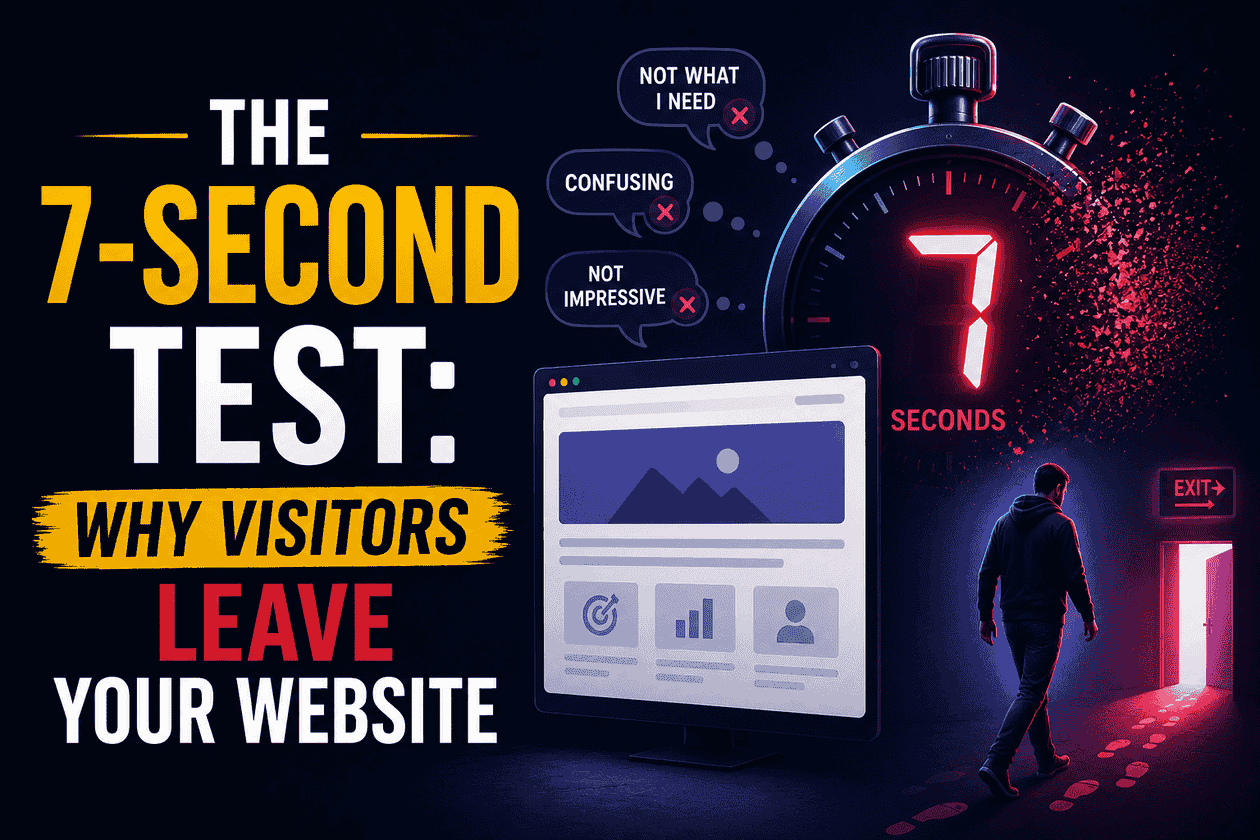
Your website has only a few seconds to make a strong first impression. Before visitors read your content, compare your pricing, or explore your services, they subconsciously decide whether your business looks trustworthy and worth their time. This is often referred to as the “7-second test”, the brief window in which users evaluate your credibility and choose whether to stay or leave.
In today’s competitive digital landscape, attention spans are shorter than ever. Users expect websites to load quickly, communicate value immediately, and provide a seamless browsing experience across every device. If those expectations are not met, potential customers often leave without taking any action, resulting in lost opportunities and wasted marketing investment.
What Makes Visitors Leave So Quickly?
One of the biggest reasons visitors abandon a website is confusion. If users cannot immediately understand what a business offers or why it is different, they are unlikely to continue exploring. A cluttered homepage, weak messaging, or poor navigation creates uncertainty that encourages people to exit rather than investigate further.
Website speed is another major factor. Even small delays in loading time can increase bounce rates and reduce conversions. Slow pages not only frustrate visitors but can also affect search visibility and overall user satisfaction.
Visual presentation also plays a significant role. Outdated layouts, inconsistent branding, low-quality images, and difficult-to-read typography can reduce trust almost instantly. A modern, clean, and professional design reassures visitors that they are dealing with a credible business.
Another overlooked issue is the lack of a clear call to action. If users don’t know what to do next—whether it’s requesting a quote, booking a consultation, or contacting the company, they often leave without engaging.
Many businesses comparing top digital marketing agencies in Dubai now place greater importance on user experience optimization alongside SEO and advertising because attracting traffic alone is no longer enough to generate meaningful business growth.
Trust signals also influence decision-making. Testimonials, client reviews, certifications, awards, case studies, and transparent company information help reduce uncertainty and encourage visitors to continue their journey through the website.
How to Pass the 7-Second Test
Creating a positive first impression starts with clarity. Your headline should immediately communicate what your business offers and the value customers can expect. Supporting text should be concise, relevant, and focused on solving real customer problems rather than using vague marketing language.
Navigation should be intuitive and uncomplicated so users can quickly find important information without frustration. Mobile responsiveness is equally essential, as a large percentage of visitors now browse primarily on smartphones and tablets.
Performance optimization should also be a priority. Fast-loading pages, compressed images, secure browsing, and technically optimized code contribute to a smoother user experience while supporting search engine performance.
Businesses investing in digital marketing services Dubai increasingly recognize that conversion optimization is just as important as traffic generation. A well-designed website with compelling messaging, fast performance, and strategically placed calls to action often delivers significantly better returns than simply increasing visitor numbers.
Consistency across branding elements further strengthens credibility. Professional visuals, cohesive design, and accurate information create confidence and encourage users to explore additional pages rather than leaving immediately.
Content quality matters as well. Visitors should quickly find useful information that answers their questions and demonstrates genuine expertise. Educational resources, client success stories, FAQs, and informative service pages contribute to stronger trust and higher engagement.
Turning First Impressions into Business Growth
Passing the 7-second test is not about flashy animations or complex designs. It’s about making visitors feel confident that they have found the right solution for their needs. Every element—from page speed and navigation to messaging and visual presentation—should work together to create a friction-free experience.
Regular website reviews, user behavior analysis, and ongoing optimization can reveal where visitors lose interest and identify opportunities for improvement. Small enhancements in usability and clarity often lead to meaningful increases in lead generation and customer acquisition.
Businesses that continuously refine their websites based on real user behavior are better positioned to improve engagement, increase conversions, and build stronger long-term relationships with their audiences.
Conclusion
The first few seconds after someone lands on your website can determine whether they become a customer or leave for a competitor. A fast, trustworthy, and user-focused website communicates professionalism, builds confidence, and guides visitors toward meaningful action.
Rather than focusing solely on increasing traffic, businesses should invest in creating experiences that immediately demonstrate value and encourage engagement. In a highly competitive digital environment, passing the 7-second test can be one of the most effective ways to improve conversions and support sustainable business growth.
Leave a Reply