

Belt conveyor systems are now one of the most dependable material handling systems in modern industries, and to understand why they hold such a strong position, it begins with recognizing what they really are.
These systems are designed to move goods, components, or materials at a constant rate with continuous movement using a continuous belt with pulleys. The concept is simple, but they prove to be beneficial in how smoothly they improve workflow, reduce manual operations, and contribute to stable production levels.
The modern-day highly dynamic operations require solutions that are readily integrated, simple to use, and able to support various types of products without frequent modifications. Belt conveyors meet these expectations by providing a reliable performance and economical functionality.
As we move through each point, you will notice how their standardization, modularity, and versatility make them an attractive option for a variety of applications.
1. Ensure Continuous and Reliable Movement
The belt conveyor systems facilitate continuous flow that assists facilities in having predictable production. Their uniform pace ensures smooth movement of work, resulting in the elimination of delays that are brought when processes are handled manually.
Their modular design makes them more useful by enabling facilities to change or increase parts as their operation changes. This flexibility also enables businesses to stay efficient in the long term without the need to change whole systems when changes or new stages are added to the business.
Moreover, their simple design makes them reliable and easy to use with little training. Employees can operate the system with confidence, managers can customize settings with ease, and factories can maintain consistent production without requiring undue complexity and disruption.
2. Adapt Easily to Facility Layouts
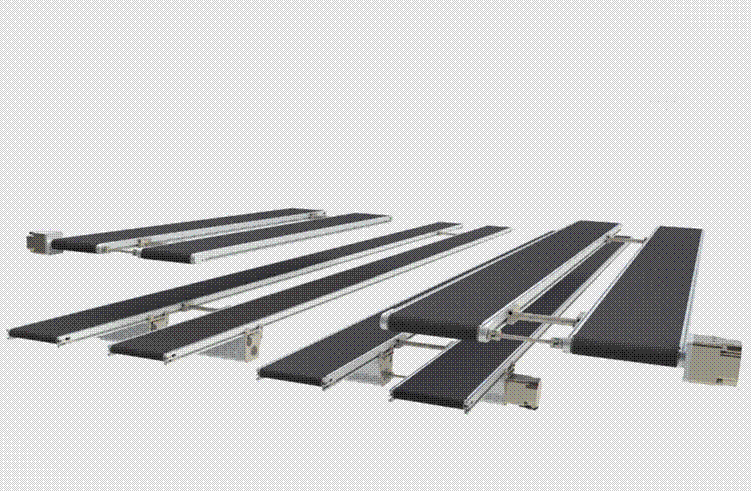
Industries prefer equipment that is compatible with their current workplaces. These conveyors suit the course of straight lines, curves, or inclines and facilitate easy motion without major restructuring and rearranging the floor space.
They are flexible enough to work in big facilities and small spaces. Such flexibility helps to support manufacturing, packaging, and inspection areas, which are as precise as possible, and the operations can flow in balance without considering space on the floor.
In addition, they are compatible with various types of products, and this makes them useful. Whether carrying delicate components or packed products, the system is meticulous in dependable transportation that fosters uniform quality expectations in different operating conditions.
3. Customize Systems for Operational Needs
Configuration allows businesses to design conveyors to specific operation requirements. Speed, length, height, and belt width adjustments allow facilities to obtain predictable handling that meets workflow needs.
There is more customization with different belt materials. Facilities have a choice of smooth, textured, antistatic, and food-grade belts, which guarantee safe and precise movement of customized products that need delicate handling or controlled transfer conditions.
Driving units, supporting structures, and directional elements are also customizable. The changes offer effective pathways that ease the transition between tasks.
4. Expand Capability Through Useful Accessories
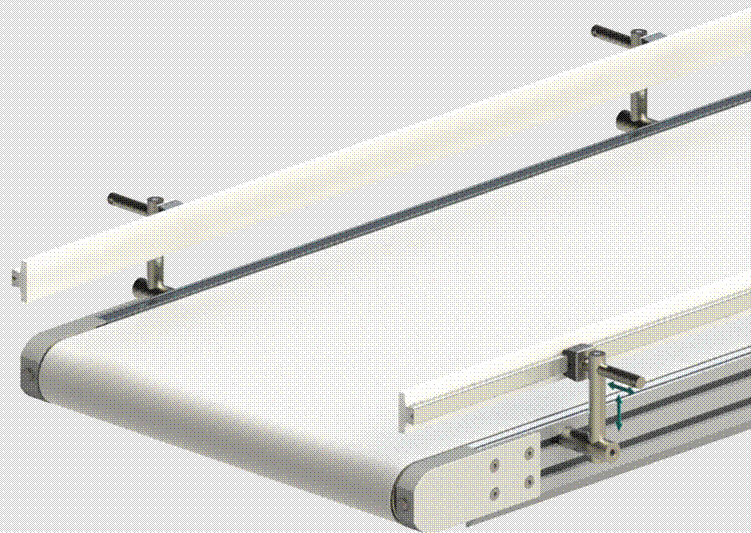
The accessories improve the functionality of a conveyor by adding capacity to it. Side rails are used to guide products safely, cleats are used in managing spacing, and sensors are used to monitor automated and hence enhance accuracy at various handling stages.
Other aspects allow conveyors to perform specialized tasks. The product flow is organized with the help of stops, hoppers, and accumulating properties in order to make the materials be carried through every step in a more consistent and effort-reducing way.
Moreover, the flexibility of accessories enables operations to streamline the performance or introduce new functionality without much interference and lengthy downtime.
5. Support Diverse Industrial Applications
These conveyors serve various industries because they are effective in handling various materials. They are used in manufacturing plants to flow the assembly process and in the packaging industry to ensure that there is consistent movement of products.
Distribution centers depend on them for sorting and handling items, and in electronic and cleanroom settings, they are valued due to their gentle transportation. This flexibility eliminates the necessity of having different material-handling systems in one facility.
Whether expanding production lines or changing the product types, the facilities can retain their consistent performance with minimal transition issues.
6. Reduce Costs Through Practical Design
Cost-effectiveness is a major advantage. Standardized components make conveyors economically accessible while maintaining durability, allowing operations to invest in reliable equipment without excessive financial commitment.
Their simple construction reduces long-term maintenance costs. Routine checks are easy to perform, and modular parts can be replaced quickly, minimizing downtime and preventing unnecessary service expenses.
As these financial benefits accumulate, businesses gain dependable performance at a manageable operational cost. This combination of affordability and functionality makes conveyors an intelligent choice for long-term productivity planning.
7. Enable Fast and Simple Deployment
Short delivery times help facilities implement improvements quickly. Standardized components support efficient assembly, allowing businesses to integrate conveyors into operations without long waiting periods or delays in workflow.
Installation is straightforward due to modular connections. Teams can position, align, and secure sections efficiently, minimizing interruption and ensuring smoother transitions during system setup or expansion.
Fast deployment supports rapid response to operational needs. Whether adjusting to increased production or optimizing workflow, facilities can benefit from improved material movement shortly after installation.
Conclusion
Belt conveyor systems remain highly popular in the industry since they offer efficiency, flexibility, and utility in a manner that few other systems have.
Their modular design allows rapid setup, their customizable nature can be used in a wide variety of applications, and the low cost of the design allows them to be used by small and large operations.
The added features of reliable performance, wide configuration options, and wide accessory provision make them offer reliable value in both simple and complex workflows.
The capacity of belt conveyor systems to enhance the movement of materials and sustain constant production is what makes them an invaluable part of the industrial operations in modern times.
Leave a Reply